

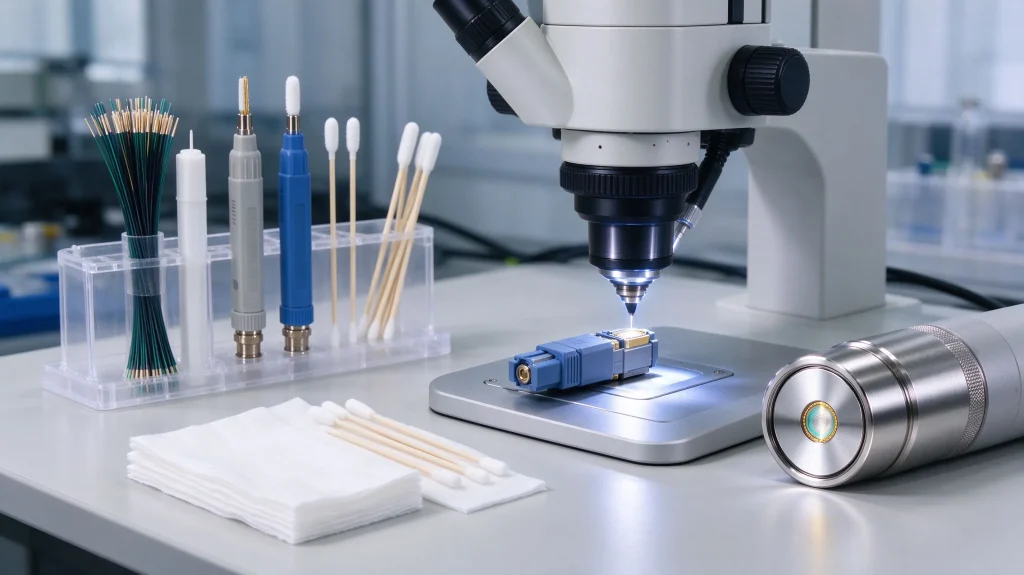
Fiber Optic Endface Cleaning and Inspection: A Practical Guide
Fiber optic endface cleaning and inspection is the single most effective way to prevent contamination-related insertion loss, back reflection, and intermittent failures in optical links. Microscopic dust, oil, and debris on a connector endface scatter light and can permanently damage transceivers, which is why every fiber optic connection in a data center or telecom network should be inspected and cleaned before mating. This guide explains what causes endface contamination, how to inspect connectors correctly, which cleaning methods work, and how to verify compliance with IEC 61300-3-35 acceptance criteria.
Why Endface Contamination Matters
Light travels through the core of a fiber, and the connector endface is the physical interface where that light must pass from one component to the next. A single speck of dust can block part of the core, increase insertion loss, and amplify return loss. In high-power applications such as DWDM systems or high-speed data center links, contaminated endfaces can absorb energy and burn the glass, permanently ruining both the connector and the mating transceiver. Because contamination is invisible to the naked eye, it often goes undetected until a link fails intermittently or an optical time-domain reflectometer trace reveals an unexplained event.
The problem is amplified in high-density environments. The smaller the connector ferrule, the more sensitive the endface becomes to particles. This is especially true for MPO/MTP multi-fiber connectors, where a single contaminated fiber among twelve or more fibers can disrupt an entire parallel link. If you are managing high-density fiber infrastructure, understanding the principles in our MPO vs MTP complete guide will help you plan for inspection and cleaning access before deployment.
Common Sources of Contamination
Contamination falls into four main categories:
- Dry particles: dust, lint, and debris picked up from the air, work surfaces, or the floor.
- Oily films: fingerprints and skin oils transferred during handling.
- Liquid residue: cleaning fluid residue, moisture, or condensation left behind by improper cleaning.
- Surface damage: scratches, pits, or chips caused by improper mating or dragging connectors across surfaces.
Most contamination is introduced during handling. Every time a connector is unplugged, its endface is exposed. Even a short exposure can collect enough dust to degrade performance. That is why our fiber patch cord selection guide emphasizes the importance of factory-terminated, pre-inspected jumpers and the need to keep protective caps in place until the moment of connection.
When to Inspect and Clean
Adopt a “three-touch” rule: inspect and clean a connector before first mating, after every unplug, and whenever a link failure or elevated loss is suspected. Cleaning should never be done “just in case” without inspection, because unnecessary cleaning can itself introduce oil or residue. In practice, the highest-risk moments are initial installation, reconfiguration, and troubleshooting of high-density panels. For organized cable management, see our fiber patch panel guide to understand how panel design affects access to endfaces.
How to Inspect Connector Endfaces
Inspection requires a fiber optic microscope or a video inspection probe with magnification sufficient to see the core region. Handheld probes are the most practical tool for field and data center work because they can inspect adapters in place without removing the connector. Always inspect both sides of a mated pair: the connector endface and the adapter or device port. Digital inspection probes with automatic pass/fail analysis reduce human error and produce documentation that is valuable for audits.
Acceptance criteria for endface quality are defined in IEC 61300-3-35, which specifies zones on the endface (core, cladding, and ferrule) and the maximum acceptable size and number of defects in each zone. Reference standards like those from the Telecommunications Industry Association (TIA) also guide inspection and cleaning practices for structured cabling. Matching polished connectors with compatible fiber optic adapters and ensuring proper fiber polarity are equally important to maintain endface integrity across the link.
Cleaning Methods That Work
Choose the cleaning method based on the contamination type and the access available:
- Dry cleaning: one-click dry cleaners and lint-free wipes remove loose dry particles. Effective for routine dust but not for oily contamination.
- Wet-to-dry cleaning: a lint-free wipe moistened with isopropyl alcohol, followed by a dry pass, removes oils and stubborn residue. This is the most reliable method for oily films.
- Reel-based cleaners: cartridge-style cleaners advance a fresh cleaning surface with each click, minimizing cross-contamination.
- Solvent pens: for spot treatment of stubborn contamination, always follow with a dry wipe and re-inspection.
Never use compressed air alone on fiber endfaces: it can deposit moisture or oil and push particles deeper. After cleaning, always re-inspect to confirm the endface meets acceptance criteria before mating. Cleaning discipline is especially important for patch cords and pigtails whose endfaces are accessed repeatedly; see our fiber pigtail selection guide for connector and ferrule choices that are easier to keep clean.
Best Practices for Preventing Re-Contamination
- Keep dust caps on every connector that is not actively in use.
- Inspect and clean connectors before mating, not after a problem appears.
- Store patch cords coiled with caps in place to avoid bending and contamination.
- Clean adapter ports with an appropriate adapter cleaner, not by inserting a contaminated connector.
- Handle connectors by the boot or connector body, never touch the ferrule or endface.
- Use polished, factory-inspected components from a reliable supplier to reduce initial defect risk.
Contamination is one of the most common hidden causes of elevated attenuation. If you are chasing a loss problem, reviewing our guide on fiber optic attenuation causes and measurement will help you separate endface issues from fiber and splice issues. For links that must stay reliable under high-density AI and cloud workloads, consistent inspection and cleaning is a low-cost habit with outsized benefits, particularly when using high-quality LC duplex patch cords and fiber adapter units across the network.
FAQ
How often should fiber optic connectors be cleaned?
Inspect and clean a connector before every mating, after every unplug, and whenever a link failure or elevated loss is suspected. In stable, fully capped environments, inspection before first use and during troubleshooting is usually sufficient.
Can I use alcohol on fiber optic connectors?
Yes, using high-purity isopropyl alcohol with a lint-free wipe in a wet-to-dry sequence is an accepted method for removing oily contamination. Always finish with a dry pass and re-inspect the endface before mating.
What is the difference between dry cleaning and wet cleaning?
Dry cleaning removes loose dust and particles using a dry wipe or one-click cleaner. Wet cleaning uses solvent to dissolve oily films and stubborn residue, followed by a dry wipe to remove any solvent residue. For oily contamination, wet-to-dry cleaning is the reliable choice.
Why does a dirty endface cause intermittent network failures?
A particle on the core scatters light inconsistently as vibration, temperature, or slight movement shifts the particle position. The result is fluctuating insertion loss that appears as intermittent errors or link drops, even though the fiber and transceiver are healthy.
Is endface inspection required by standards?
IEC 61300-3-35 defines endface geometry and defect acceptance criteria for single-fiber and multi-fiber connectors. Many enterprise and hyperscale data center programs require documented inspection results before new links are accepted into service.
Module architecture changes how much of that cleaning margin is available. Linear pluggable optics rely entirely on host equalisation, so a contaminated endface that a retimed module would tolerate can push a linear link past its FEC threshold. The link-budget and acceptance rules for that case are in the LPO deployment guide for 800G AI fabrics.