
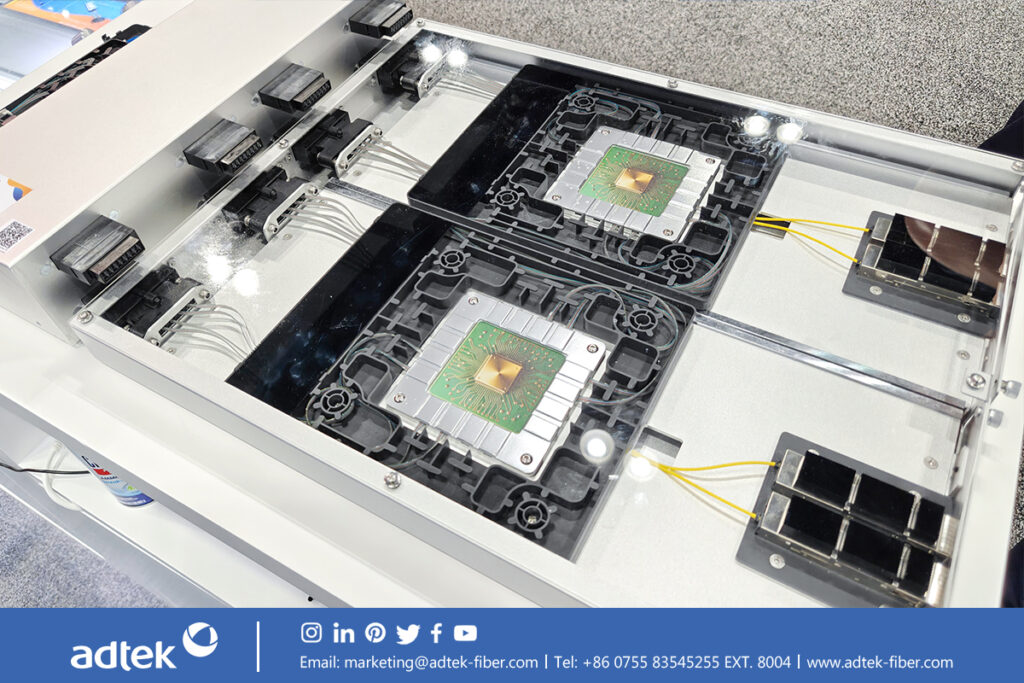
Why Optical Scale-Up Is Slower Than Expected
The industry narrative is clear: NVLink-based architectures are gaining traction, and Co-Packaged Optics (CPO) is often positioned as the next step in AI infrastructure evolution.
However, in real deployment terms, the transition to fiber-based scale-up is progressing more slowly than expected.
Based on current validation cycles and infrastructure readiness, large-scale adoption of optical interconnect architectures is unlikely before 2028.
This delay is not driven by limitations in physics—but by practical constraints in thermals, power density, and system-level economics.
Thermal Constraints and Reliability at High Power Density
As AI clusters scale, power density is approaching—and in some cases exceeding—100W/cm².
At this level, engineering challenges shift fundamentally:
- Thermal management becomes a system-level constraint rather than an optimization problem
- Reliability extends from individual components to full rack-level stability
- Cooling architecture begins to dictate system design decisions
In several validation scenarios, CPO-based systems already require advanced liquid cooling, forcing a redesign of rack-level infrastructure.
This is not a marginal upgrade—it is a structural change in how data centers are built.
Market Reality: Cautious Deployment Strategies
Across the industry, deployment strategies are becoming more conservative.
- Tier 1 hyperscalers are prioritizing validation over rapid rollout
- Tier 2 cloud providers and telecom operators are focusing on long-term reliability and operational risk
The question is no longer whether optical interconnects will dominate, but whether current solutions are ready for production-scale deployment.
OFC 2026: Innovation vs. Deployment Gap
At OFC 2026, emerging architectures such as Near-Package Optics (NPO) attracted strong attention.
From a technical perspective, NPO demonstrates clear potential:
- High-density integration
- Improved signal performance at 200G / 400G per lane
However, from a deployment standpoint, these solutions remain at the proof-of-concept stage and are not yet aligned with near-term production roadmaps.
This gap between innovation and deployability is one of the most critical friction points in the industry.
Early Validation Work Behind the Scenes
While large-scale deployment is still ahead, early-stage validation efforts are already underway.
ADTEK is working with industry partners to support evaluation of next-generation optical architectures, focusing on:
- Thermal validation under high-density conditions
- Laser reliability in real-world environments
- Forward-looking power architectures, including 800VDC systems
These are not theoretical exercises—they are essential prerequisites for scalable deployment.
A Structural Risk: Vendor Lock-In Returning
Beyond technical challenges, a structural concern is emerging.
Over the past decade, hyperscale infrastructure has shifted toward open and disaggregated architectures.
However, current CPO and NPO ecosystems show a different trend:
- Vertically integrated stacks
- Proprietary interfaces
- Limited interoperability
For telecom operators and regional cloud providers, this introduces potential risks in flexibility and long-term scalability.
After years of moving away from vendor lock-in, the industry may be facing a return to it.
What Can Be Deployed Today
While optical architectures define the future, current AI infrastructure must solve immediate deployment challenges.
Key focus areas include:
- Multi-fabric complexity across scale-up, scale-out, PCIe/CXL, and storage
- Signal integrity at 224G in high-density environments
- Stability of hybrid power systems (800VDC / 48VDC)
At present, many deployments still rely on copper-based solutions and high-speed connectivity products to ensure stable operation.
Bridging the Gap Between Today and the Optical Future
The long-term direction is clear: optical interconnects will play a central role in AI infrastructure.
However, the transition is not immediate.
Between today’s deployments and future optical architectures lies a critical phase of validation, system redesign, and ecosystem development.
ADTEK will continue to share insights from this transition, including upcoming technical research on early-stage CPO deployment.
Conclusion
The future of AI infrastructure is optical.
But the present is defined by what can be deployed reliably, economically, and at scale.
Today, that still means a combination of copper-based systems, hybrid architectures, and pragmatic engineering decisions.
Optical adoption is not a question of “if,” but “when”—and that timeline depends on solving real-world constraints, not just advancing technology.
Related articles
Share the page:
Contact US
If you want to know more about us, you can fill out the form to contact us and we will answer your questions at any time.
One Response