

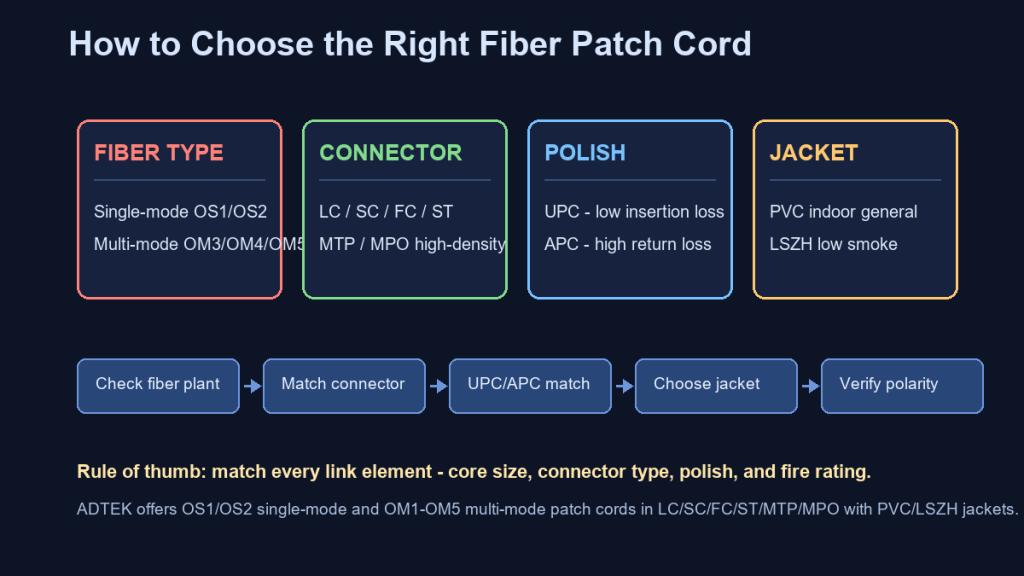
Short answer: To choose the right fiber patch cord, match four things: fiber type (OS1/OS2 vs OM1-OM5), connector type and polish (LC/SC/FC/ST/MTP-MPO; UPC vs APC), jacket rating (PVC vs LSZH vs outdoor), and configuration (simplex, duplex, breakout, or trunk). Confirm the insertion/return loss on the datasheet and never mix UPC with APC or 50 µm with 62.5 µm in the same link.
Why Patch Cord Selection Matters
The fiber patch cord is the last meter of every optical link, yet it is often the source of avoidable failures. A patch cord that does not match the fiber type, connector polish, or jacket rating can cause insertion loss, return loss, and even fire-safety compliance issues. This guide walks through each selection decision so the right cord is chosen the first time for data centers, FTTH, campus networks, and telecom rooms.
Single-Mode vs Multi-Mode: Start with the Fiber Type
The fiber core size determines which patch cord families are compatible with the network. Single-mode fiber uses a 9/125 micron core and is the standard for long reach, WDM, and high-speed transport. Multi-mode fiber uses 50/125 or 62.5/125 micron cores and is common in short-reach data center links where parallel optics and VCSEL transceivers are used.
| Fiber type | Core/cladding | Wavelength | Typical reach | Common use |
|---|---|---|---|---|
| OS1/OS2 single-mode | 9/125 µm | 1310/1550 nm | Long (km scale) | Metro, backbone, DCI, FTTH |
| OM1 multi-mode | 62.5/125 µm | 850/1300 nm | Up to ~300 m (legacy) | Legacy LAN backbone |
| OM2 multi-mode | 50/125 µm | 850/1300 nm | Up to ~500 m (legacy) | Legacy LAN |
| OM3 multi-mode | 50/125 µm | 850 nm | 100 m @ 10G, 100 m @ 40/100G SR | Data center parallel optics |
| OM4 multi-mode | 50/125 µm | 850 nm | 150 m @ 100G SR, 100 m @ 400G | High-speed data center |
| OM5 multi-mode | 50/125 µm | 850/953 nm | SWDM distances | Short wavelength division multiplexing |
Use the same fiber category on the patch cord as on the installed cabling. Mixing 62.5 µm and 50 µm multi-mode fibers creates loss at every transition, so keep the core size consistent end to end. For a deeper look at how attenuation and reach depend on fiber class, read our fiber optic attenuation guide.
Connector Types: LC, SC, FC, ST, and MTP/MPO
The connector determines compatibility with transceivers, patch panels, and field equipment. LC is the dominant connector for modern transceivers because of its small footprint and duplex design. SC is widely used in FTTH and enterprise networks. FC and ST appear in legacy and specialized installations, while MTP/MPO supports high-density parallel optics in today’s data centers.
| Connector | Form factor | Typical application |
|---|---|---|
| LC | Small duplex | Transceivers, data center, enterprise |
| SC | Push-pull duplex | FTTH, patch panels, enterprise |
| FC | Screw-on | Test equipment, legacy telco |
| ST | Bayonet | Legacy LAN and instrumentation |
| MTP/MPO | Multifiber array (8/12/16/24) | 40G/100G/400G parallel optics, trunk cabling |
| SN / CS / MDC | Ultra-compact duplex | High-density next-gen data center |
For high-density environments, consider breakout cords that convert MTP/MPO trunk interfaces into LC duplex fan-outs, simplifying the transition between parallel optics and conventional transceivers. Our multi-fiber pre-terminated assemblies and trunk fiber patch cords cover both ends of that migration, and the MPO-ELSFP connector patch cord shows how MPO is adapting to new module interfaces.
Connector interface dimensions for LC, SC, FC, ST, and MTP/MPO are standardized in the IEC 61754 series (IEC), which is why different brands of the same connector type mate reliably in the field.
Polishing: UPC vs APC
The polish of the ferrule endface determines return loss and is a compatibility constraint that cannot be mixed carelessly. UPC (ultra physical contact) connectors offer very low insertion loss and moderate return loss, and are standard for most data center and enterprise links. APC (angled physical contact) connectors have an 8-degree angled endface that reflects light away from the core, giving the highest return loss and is required for RF video and many WDM systems.
UPC and APC connectors must never be mated directly, and mixing them across a link is a common field error. Check both ends of every patch cord and the ports they plug into. The endface finish is one of the reasons physical contact in fiber connector ferrules is such a sensitive parameter in assemblies.
Jacket Material and Fire Ratings: PVC vs LSZH
The jacket determines mechanical protection, bend resistance, and fire behavior. PVC jackets are flexible, inexpensive, and suitable for general indoor use. LSZH (low smoke zero halogen) jackets emit little smoke and no halogen when burned, making them the preferred choice for public areas, raised floors, and environments with strict fire-safety requirements.
| Jacket | Fire behavior | Typical location |
|---|---|---|
| PVC | Flexible, general purpose | Indoor, equipment rooms |
| LSZH | Low smoke, zero halogen | Public areas, ventilation spaces, data halls |
| Outdoor / waterproof | Water-blocking, rugged | Outdoor, FTTH drop, industrial |
Outdoor installations need waterproof and UV-resistant jackets, while indoor riser or plenum-rated jackets may be required by local building codes.
Simplex, Duplex, and Multifiber Configurations
Patch cords come in simplex, duplex, and multifiber configurations. Simplex cords carry a single fiber and are used for single-fiber systems and some test setups. Duplex cords carry two fibers in a side-by-side or zipcord construction and are the standard for transceivers that use separate transmit and receive fibers. Multifiber cords, including MTP/MPO trunks and pre-terminated assemblies, carry 8, 12, 16, or 24 fibers in one pluggable interface for high-density parallel links.
Polarity matters in duplex and multifiber systems. Keyed connectors and correct A/B alignment ensure transmit and receive fibers are matched between both ends; using the wrong polarity is one of the most common causes of non-working links in MTP/MPO deployments. Our fiber polarity guide walks through Method A, B, and C so you can specify the right cord the first time.
Key Specifications to Check Before Ordering
| Parameter | What to check |
|---|---|
| Fiber type | OS1/OS2, OM1-OM5 matching the link |
| Connector type and polish | LC/SC/FC/ST/MTP/MPO; UPC or APC consistency |
| Insertion loss | Low and stable, per datasheet |
| Return loss | Matches the system requirement (APC for high return loss) |
| Jacket rating | PVC, LSZH, outdoor/waterproof per location |
| Configuration | Simplex, duplex, breakout, or trunk |
| Length | Planned with service loops and routing margins |
If your deployment is a high-density data center, the same trade-offs show up at every layer: connector density, MPO vs MTP selection, and high-density fiber deployment best practices are worth reading together. For the full portfolio, browse our fiber optic product series.
Frequently Asked Questions
Can I use a single-mode patch cord on a multi-mode link?
Physically the LC connector may fit, but the core sizes do not match and the link will suffer from high loss at the transition. Always match the fiber category of the patch cord to the fiber plant.
What is the difference between a breakout cord and a trunk cord?
A trunk cord is a multifiber cable terminated with MTP/MPO connectors on both ends. A breakout cord (or fan-out) takes a multifiber interface and fans out to individual LC or SC duplex connectors, letting parallel optics connect to conventional transceivers.
Why do data centers prefer LC connectors today?
LC’s small duplex footprint fits the high port density of modern transceivers and patch panels, while still supporting the reach and performance required in data center links. High-density environments may move to even smaller connectors such as SN, CS, or MDC.