

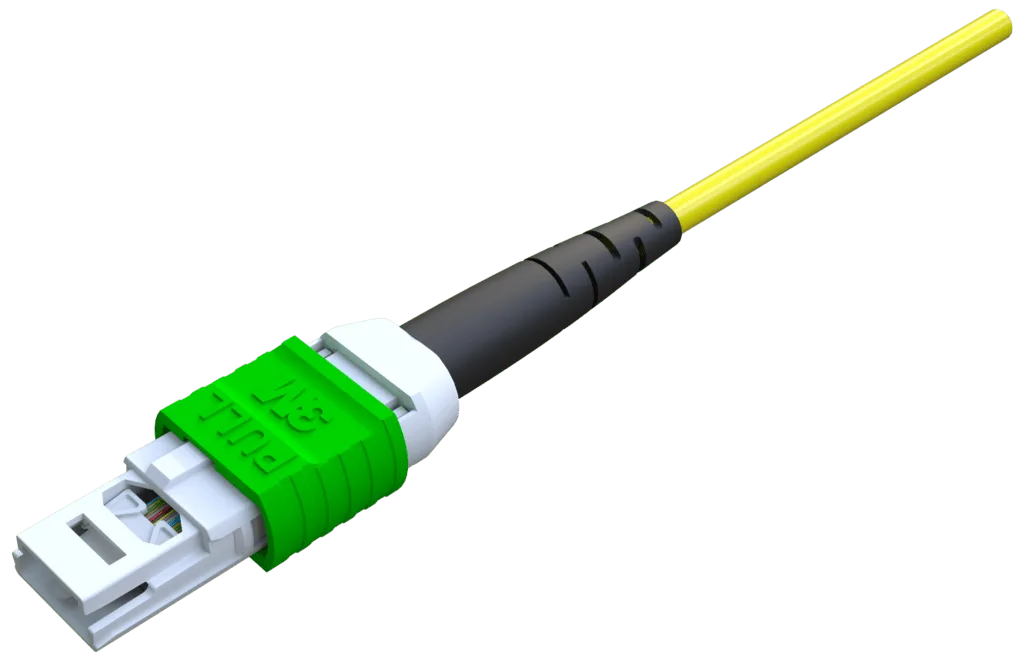
Short answer: MPO is the industry-standard multi-fiber push-on connector defined by IEC 61754-7 and TIA-604-5, while MTP is US Conec’s trademarked, performance-enhanced version of that same MPO format. They are mechanically interoperable, but MTP adds tighter ferrule tolerances, a floating ferrule, and removable guide pins that deliver lower insertion loss for high-density 400G/800G data center links. This guide compares both connectors and shows when the MTP premium is worth paying.
MPO vs MTP: What’s the Difference?
If you work with high-density fiber optic cabling, you have probably seen the terms MPO and MTP used almost interchangeably. They describe the same physical connector format, but the two names are not identical in origin, tolerances, or performance. Understanding the difference matters when you are designing a data center, upgrading to 400G or 800G, or purchasing trunk cables for a structured cabling system.
What Is an MPO Connector?
MPO stands for Multi-fiber Push On. It is a fiber optic connector standard defined under IEC 61754-7 and TIA-604-5, designed to terminate multiple fibers in a single ferrule. A standard MPO connector supports 8, 12, 16, or 24 fibers depending on the ferrule configuration, and it enables rapid deployment of high-density pre-terminated trunk and breakout systems, and cassette-based patching.
Because MPO is a standard defined by specifications, any manufacturer can build to it. In practice, that means MPO connectors from different vendors should mate mechanically, but ferrule geometry and polish quality can vary, which affects insertion loss and long-term stability. The physical contact behavior of the ferrule is a key reason why ferrule quality matters so much in fiber assemblies.
What Is an MTP Connector?
MTP is the registered trademark of US Conec for its enhanced MPO connector. MTP connectors are fully compliant with the MPO standard, but they add engineering improvements that address the weaknesses found in generic MPO designs:
- Tighter ferrule tolerances for lower, more predictable insertion loss.
- Spring-loaded floating ferrule that improves physical contact between mated connectors.
- Elliptical guide pins and precision alignment that reduce fiber damage during mating.
- Removable, replaceable guide pins (male/female field reconfiguration).
- Metal alignment pins and a polished, debris-resistant ferrule.
The result is a connector that meets the MPO standard but delivers better optical performance, especially in high-fiber-count, high-density environments where every tenth of a dB counts.
Key Differences at a Glance
| Aspect | MPO | MTP |
|---|---|---|
| Definition | Standard multi-fiber connector (IEC/TIA) | US Conec brand, MPO-compliant enhanced design |
| Ferrule tolerance | Standard | Tighter, lower loss |
| Guide pins | Fixed male/female | Removable, replaceable |
| Housing | Standard push-on | Enhanced spring-loaded floating ferrule |
| Interoperability | Mates with MPO/MTP | Mates with MPO/MTP |
| Typical loss | 0.3–0.6 dB (12F) | 0.1–0.35 dB (12F) |
| Price | Lower | Premium |
Why Does This Matter for Data Centers?
Modern AI and cloud data centers are pushing beyond 400G per port toward 800G and 1.6T. Higher speeds mean tighter optical budgets and smaller acceptable loss. Two practical consequences:
1. Lower loss extends reach. In a large spine-leaf fabric, a trunk cable with 0.6 dB insertion loss per MPO pair consumes budget fast. MTP-grade components reduce that loss, leaving more margin for connectors, splices, and attenuation along the full channel. For a practical view of how much fiber a single AI rack consumes, see our analysis of fiber counts in AI data centers.
2. Field reconfiguration matters. With removable guide pins, an MTP cassette or trunk can be changed from male to female in the field, which simplifies polarity management and reduces inventory SKUs.
Can You Mix MPO and MTP?
Yes. Because MTP is fully MPO-compliant, MTP connectors mate with standard MPO connectors. The reverse is also true. However, mixing generic MPO with MTP in a mission-critical link means you inherit the worst-case tolerances of the generic component. For best performance, keep both ends of a link on MTP-grade hardware, especially above 400G. If you are building high-density parallel links, browse our MTP/MPO connector assemblies guide and the MPO-ELSFP connector patch cord for next-generation module interfaces.
How to Choose: MPO or MTP?
- Budget-constrained, low-density links (40G/100G, short runs): standard MPO is usually sufficient.
- High-density, high-speed fabrics (400G/800G, AI clusters): choose MTP for lower loss and reliability.
- Polarity flexibility and fewer SKUs: MTP’s removable pins simplify field changes.
- Always confirm fiber count: 8F vs 12F vs 16F vs 24F MPO/MTP trunks serve different parallel optics architectures. Array-based products such as our high-density fiber array units show how fiber count and alignment drive connector design.
For a deeper look at trunk configurations, see our Trunk Fiber Patch Cords overview, browse the full fiber optic product series, or read how high-density fiber deployment best practices keep large fabrics reliable.
Frequently Asked Questions About MPO and MTP
Is MTP just a brand name?
Yes. MTP is a registered trademark of US Conec. The underlying design is an enhanced version of the standard MPO connector and remains fully interoperable with MPO hardware.
Are MPO and MTP connectors interchangeable?
They are mechanically interchangeable. You can mate an MTP plug with an MPO adapter and vice versa. Optical performance, however, is limited by the weaker component in the link.
How many fibers does an MPO/MTP connector support?
Common configurations are 8, 12, 16, and 24 fibers. 16F and 24F are increasingly used for 400G and 800G parallel optics based on the QSFP-DD and OSFP form factors.
Do I need MTP for 400G?
Not strictly, but it is recommended. 400G-DR4 and 800G links have tight loss budgets; MTP’s tighter tolerances provide more margin and better consistency across large fabrics.
What is the typical insertion loss of MPO vs MTP?
A 12-fiber MPO pair typically measures 0.3–0.6 dB, while MTP-grade pairs often achieve 0.1–0.35 dB under the same conditions, depending on polish and alignment.