

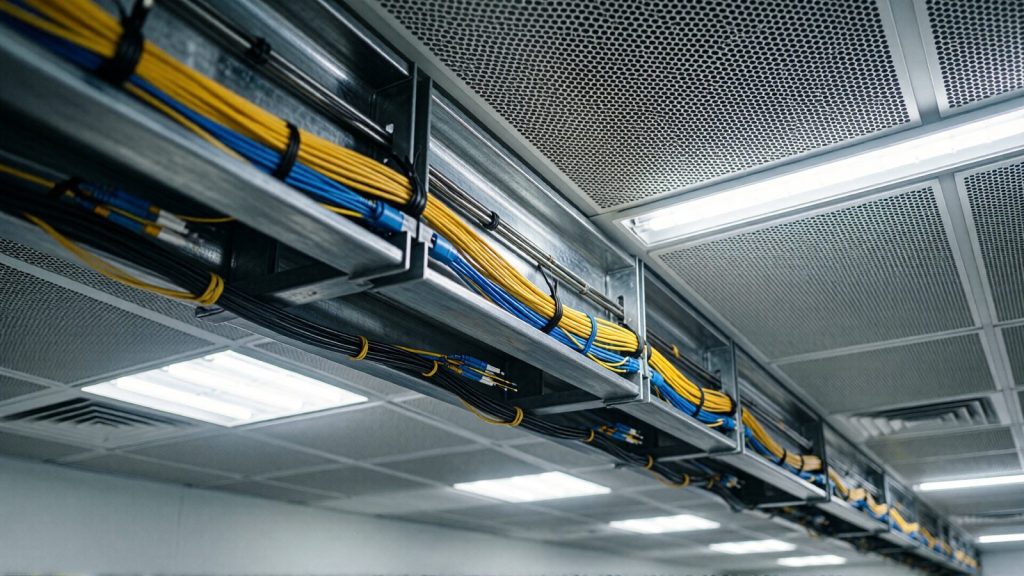
Few decisions in a fiber project cause more late-stage rework than the jacket rating. The optical design can be flawless — correct strand count, validated loss budget, clean polarity — and the installation can still be rejected at inspection because a length of cable in an air-handling ceiling or a floor-to-floor shaft does not carry the rating that the local code requires for that pathway. Unlike bandwidth or connector loss, fire rating is not a performance trade-off you can engineer around after the fact. It is a legal attribute of the product, printed on the jacket and declared in a test report, and it must match the space it is installed in.
The confusion is compounded because the industry uses three vocabularies that look interchangeable but are not. Plenum and riser are pathway ratings defined by North American test methods and codified in the National Electrical Code. LSZH (low smoke zero halogen) is a material and performance description rooted in IEC test methods and, in Europe, in the Construction Products Regulation. A cable can be plenum rated without being low-halogen, and a cable can be proudly marketed as LSZH while having no standing at all in a North American plenum. This guide separates the three, shows what each test actually measures, and gives you the selection tables and procurement checklists needed to specify correctly the first time.
1. Fire rating is a code question before it is an engineering question
Two regulatory systems dominate, and they do not use the same language. In the United States and in jurisdictions that adopt the National Electrical Code, cable selection in air-handling spaces and vertical shafts is governed by NFPA 70, the National Electrical Code. Article 300.22 addresses wiring in ducts, plenums and other spaces used for environmental air, and Article 770 defines the permitted optical fiber cable types and their marking. The enforcement mechanism is the type letter: OFNP, OFNR, OFNG and their conductive counterparts. An inspector does not evaluate your cable’s chemistry; they read the print legend on the jacket and compare it with the space.
In the European Union, the mechanism is different. Cables permanently installed in buildings are construction products, and under Regulation (EU) No 305/2011, the Construction Products Regulation, they must be CE marked with a Declaration of Performance that states a reaction-to-fire class defined in the EN 13501-6 classification system and tested under the EN 50575 harmonized standard. The class letters — Aca through Fca — are not marketing adjectives; they are declared performance, and a supplier who cannot produce a DoP with a class is not selling a compliant building cable.
Because these two systems run in parallel, multinational projects routinely carry both requirements in a single bill of materials. A hyperscale campus in Europe built to a US parent company’s global standard frequently ends up specifying a cable that must satisfy a NEC type letter and a CPR class at the same time. That is achievable, but only if the requirement is written into the purchase order rather than discovered at commissioning.
2. Three hazards, three different measurements
All fire-rated cable standards exist because a cable burning inside a building causes three distinct problems, and no single test measures all three well.
- Flame propagation. A burning cable is a fuel source that can carry fire from the point of ignition into rooms and floors that would otherwise be protected. Tests that measure this apply a defined flame to a defined sample geometry and record how far the flame front travels, or whether the sample self-extinguishes.
- Smoke obscuration. In a plenum, smoke does not stay where the fire is; the return-air path distributes it through the building. Optical density is therefore measured as a first-class criterion, not an afterthought. Smoke is also the primary life-safety hazard long before flame reaches an occupied space.
- Corrosive and toxic combustion products. Halogenated polymers release hydrogen chloride, hydrogen fluoride and other acid gases that attack electronics, contaminate switchgear and damage stored materials far beyond the fire zone. This is measured as acid gas content, pH and conductivity of the combustion effluent.
The practical consequence is that “fire rated” is never a complete statement. Plenum and riser ratings are weighted heavily toward flame spread in a specific installation geometry, with smoke limits added for plenum. The IEC family and the CPR classes add explicit acid-gas and smoke-transmittance tests. Knowing which hazard a given space makes dominant is how you choose between them.
3. Plenum rating: NFPA 262 and the OFNP / OFCP designations
A plenum is a space used to move conditioned air — typically the ceiling void above a suspended ceiling, or a raised-floor void, where return air travels without dedicated ductwork. Because the space is part of the air distribution system, everything inside it is effectively inside the duct. North American codes therefore demand the most demanding cable rating available for indoor use.
The governing test is NFPA 262, Standard Method of Test for Flame Travel and Smoke of Wires and Cables for Use in Air-Handling Spaces, which evolved from the UL 910 Steiner tunnel method. A cable sample is mounted in a horizontal tunnel roughly 25 ft long with controlled airflow and a gas burner at the upstream end. The test records flame travel distance, peak optical density and average optical density of the smoke. To pass, a cable must simultaneously satisfy the flame-spread limit, the peak smoke limit and the average smoke limit — the widely applied thresholds are a maximum flame travel of about 5 ft, a peak optical density no greater than 0.50 and an average optical density no greater than 0.15. All three must be met; excellent flame performance with heavy smoke is a failure.
In the NEC type system, plenum-rated optical fiber cable is designated OFNP (nonconductive) or OFCP (conductive, containing a metallic member). Both may be installed in plenums, risers and general-purpose spaces. The distinction between the N and C variants matters for grounding and bonding: a conductive plenum cable introduces a metallic path that must be handled per Article 770, while a dielectric OFNP cable does not.
What the rating costs you is mostly chemistry. Passing NFPA 262 normally requires either fluorinated polymer jackets and buffer materials or heavily filled low-smoke PVC formulations. Both raise compound cost, and fluoropolymers in particular raise stiffness and reduce flexibility, which changes bend radius behaviour and handling in tight cabinets. It is worth being precise about one frequently missed point: plenum rated does not mean halogen free. Fluoropolymers contain fluorine and will generate hydrogen fluoride under fire conditions. If a facility needs both plenum classification and low corrosivity — a common requirement in telecom rooms full of electronics — that must be specified explicitly, not assumed from the plenum letter.
4. Riser rating: UL 1666 and the OFNR / OFCR designations
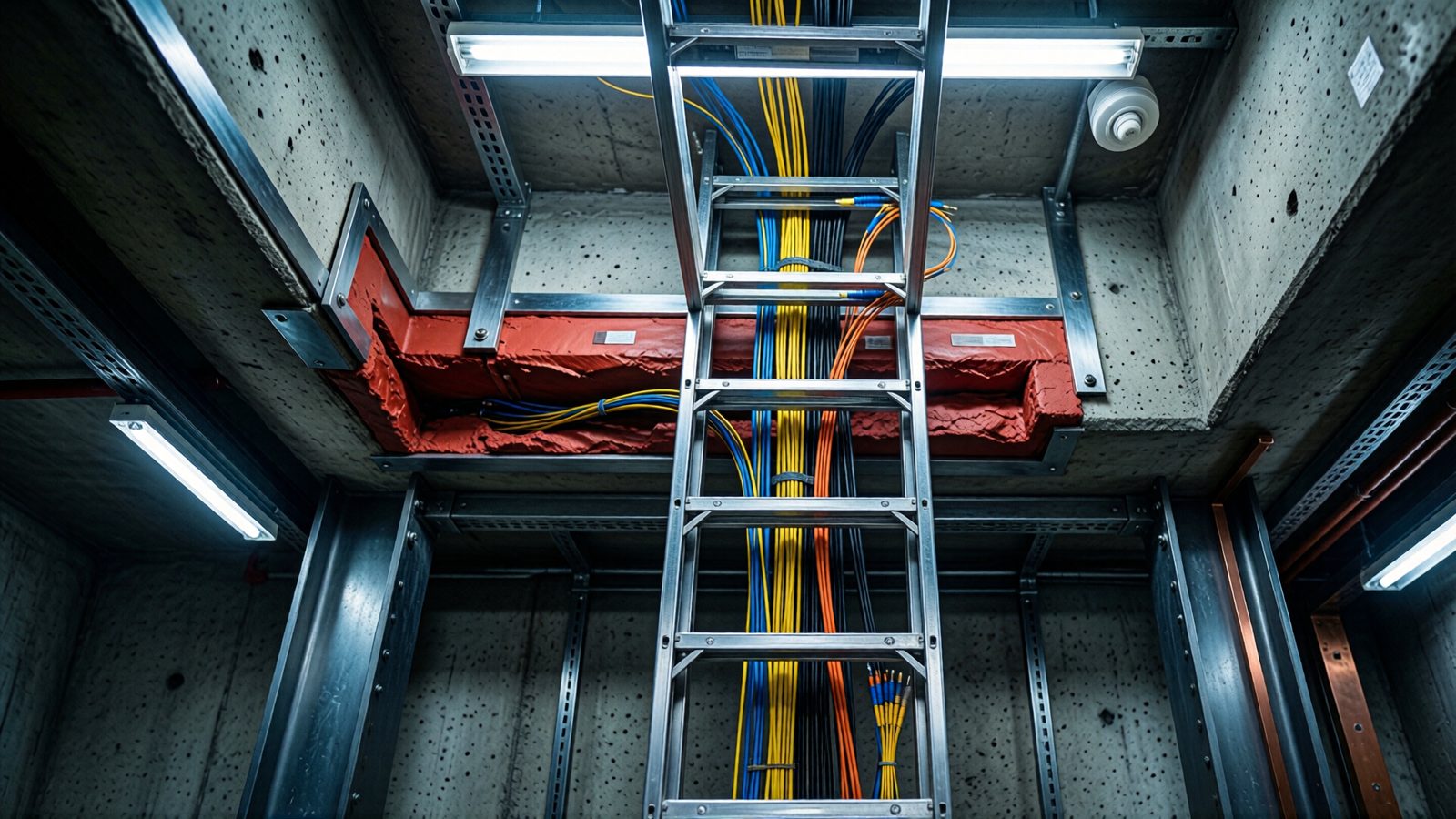
A riser is a vertical shaft that carries cable between floors. Fire in a shaft behaves like a chimney: the stack effect accelerates upward spread and preheats cable above the fire, so the test geometry is deliberately vertical. The governing North American method is UL 1666, the standard test method for flame propagation height of electrical and optical-fiber cables installed vertically in shafts.
The test places cable in a vertical chase and ignites it at the base with a specified burner. Pass criteria are expressed as a maximum flame propagation height measured from the test floor — commonly quoted as 12 ft (about 3.7 m) — together with a limit on the temperature measured near the top of the chamber. The temperature criterion is what prevents a cable that technically stops burning from still heating the shaft enough to ignite material above it.
In the type system, riser-rated cable is OFNR (nonconductive) or OFCR (conductive). Both may be installed in risers and in general-purpose spaces, but neither may be installed in a plenum. This asymmetry trips up more projects than any other single rule: the cable in the ceiling void and the cable in the shaft are frequently the same part number in a designer’s head, and they must not be. Riser cable is generally lower cost and more flexible than plenum cable, which is exactly why substitution attempts happen and exactly why inspectors check the print legend at both ends of a run.
5. What LSZH actually means — and what it does not
LSZH describes the jacket compound and its combustion behaviour, not a pathway classification. A low smoke zero halogen cable is formulated with halogen-free polymers — typically filled polyethylene, EVA or specialised thermoplastic compounds — so that on decomposition it releases minimal acid gas and produces limited, less opaque smoke. The claim is only meaningful when it is backed by the IEC test family, because “zero halogen” is a formulation statement while the standards measure outcomes: halogen acid gas content, effluent pH and conductivity, and smoke transmittance.
Three attributes follow, and each one is routinely misunderstood.
First, LSZH is a materials designation that must be evidenced, not a grade. The relevant tests are IEC 60754-1 for halogen acid gas content, IEC 60754-2 for pH and conductivity of the evolved gas, and IEC 61034-2 for smoke density under defined burning conditions. A supplier claiming LSZH without test reports is making an unverifiable claim, and in the EU such a cable cannot be legally placed on the market for permanent building installation at all, because the CPR requires a declared class.
Second, LSZH in North America does not substitute for a plenum rating. This is the most consequential confusion in the entire subject. NFPA 262 measures flame travel and optical density in a horizontal air-handling tunnel; IEC 60332 and IEC 61034 measure different quantities in different geometries. A cable can pass IEC 60332-3-24 Category C and IEC 61034-2 and still fail NFPA 262. North American authorities having jurisdiction accept the NEC type letter, so an LSZH-only cable in a plenum is a code violation regardless of how good its IEC results are. The reverse is equally true: a plenum cable is not automatically LSZH, as noted above.
Third, LSZH matters most where people and electronics share confined space. Metro tunnels, stations, hospitals, data halls with high equipment value, ships, rolling stock and any space with limited egress benefit disproportionately from reduced acid gas and reduced smoke obscuration. In those environments the specification should name the IEC tests and their thresholds, not merely the phrase LSZH.
6. The IEC test family: what each standard actually measures
The IEC family is modular by design, and a compliant LSZH specification normally cites several parts together. Reading them as a set makes the logic clear: one part addresses flame spread, two address gas corrosivity, one addresses smoke. The individual parts are published and maintained through the IEC standards catalogue, which is where current editions and amendment status should be checked before the requirement is written into a specification.
| Standard | What it measures | Typical specification reference |
|---|---|---|
| IEC 60332-1-2 | Vertical flame spread on a single insulated wire or cable with a 60-second flame application; assesses self-extinguishing behaviour | Basic flame retardance, cited for patch cords and small cables |
| IEC 60332-3-24 | Bunched cable vertical flame spread, Category C: flame applied to a tray of cables for 20 minutes at a non-metallic volume of about 1.5 L/m | Bunched trunk and backbone cables; Category A (7 L/m, 40 min) and B (3.5 L/m, 40 min) for higher-hazard routes |
| IEC 60754-1 | Halogen acid gas content of gases evolved during combustion | Halogen-free verification, typically capped at 0.5% by weight |
| IEC 60754-2 | pH and conductivity of the aqueous solution of evolved gases | Corrosivity limits, commonly pH not below 4.3 and conductivity not above 10 µS/mm |
| IEC 61034-2 | Smoke density measured as light transmittance in a defined chamber | Low-smoke verification, commonly a minimum of 60% transmittance |
Two practical notes. First, IEC 60332-1-2 and IEC 60332-3-24 answer different questions — single cable versus bunched tray — and passing the single-cable test says very little about behaviour in a densely filled tray, which is the situation in most real backbones. Second, flame-retardant chemistry usually trades against smoke and halogen performance: formulations that excel at one often regress on another, which is why a serious specification states thresholds for all four attributes rather than a single headline claim.
7. EU CPR: reading the class letters correctly
Under the CPR and EN 50575, reaction-to-fire performance is classified using EN 13501-6. The main classes run from Aca (highest performance) down to Fca (no demonstrated performance). For optical fiber cables in buildings, the classes that appear in practice are B2ca, Cca, Dca and Eca, with the additional classifications appended to describe smoke, flaming droplets, acidity and heat release.
| Class | Performance level | Where it is typically specified |
|---|---|---|
| Aca | Highest; essentially non-combustible | Special applications; rarely used for fiber |
| B1ca | Very limited contribution to fire | High-risk areas, some transport infrastructure |
| B2ca | Limited contribution to fire | Escape routes, high-occupancy and high-value spaces; increasingly common in data centers |
| Cca | Moderate contribution to fire | General building horizontal and backbone cabling; the most common baseline in commercial projects |
| Dca | Acceptable contribution to fire | Lower-risk, small buildings and limited quantities |
| Eca | Basic fire behaviour | Minimum acceptable for many indoor routes |
| Fca | No performance determined | Not acceptable for permanent building installation in most member states |
The suffix letters carry real requirements and should never be dropped from a specification. Smoke classes s1, s2 and s3 describe smoke production, with s1 the most restrictive. Flaming droplet classes d0, d1 and d2 describe burning droplets, d0 being none. Acidity classes a1, a2 and a3 describe the corrosivity of combustion products, a1 the lowest. A specification written as “B2ca-s1a,d1,a1” is a complete statement; “B2ca” alone leaves the smoke and acidity behaviour undefined, which is precisely the gap that causes disputes after a substitution.
There is one more compliance item that is frequently overlooked: the Declaration of Performance and the CE marking apply to the product as placed on the market. If you buy factory pre-terminated assemblies, the assembly — not just the bulk cable — must be traceable to a declaration, and the reel of bulk cable used inside it must itself carry the declared class. Projects have been rejected because the bulk cable was compliant but the finished assembly carried no assembly-level documentation.
8. Side-by-side comparison
| Attribute | Plenum (OFNP / OFCP) | Riser (OFNR / OFCR) | LSZH (IEC based) | General purpose (OFN / OFNG) |
|---|---|---|---|---|
| Governing test | NFPA 262 | UL 1666 | IEC 60332 series, 60754, 61034 | Vertical wire flame test, no pressure or smoke criteria |
| Primary hazard addressed | Flame travel plus smoke in air-handling space | Vertical flame propagation in a shaft | Flame spread, acid gas, smoke transmittance | Basic flame retardance |
| Smoke criterion | Yes, peak and average optical density | Indirect, via temperature limit | Yes, light transmittance | No |
| Halogen-free by definition | No | No | Yes, when tested to IEC 60754 | No |
| Permitted in plenum | Yes | No | Not by itself in North America | No |
| Permitted in riser | Yes | Yes | Only where local code maps it to a riser class | No |
| Typical jacket chemistry | Fluoropolymer or filled low-smoke PVC | Flame-retardant PVC or equivalent | Halogen-free filled polyolefin compounds | PVC or similar |
| Relative cost | Highest | Moderate | Moderate to high | Lowest |
| Handling | Stiffer, larger bend radius | Reasonably flexible | Moderately flexible, compound dependent | Most flexible |
9. Selection table by installation location
The table below maps the space to the requirement. It assumes North American code adoption in the left column and EU CPR in the right; projects in other regions usually follow one of the two, sometimes with a national amendment on top.
| Installation location | North America (NEC) | European Union (CPR) |
|---|---|---|
| Ceiling void used as return air plenum above occupied space | OFNP or OFCP mandatory | No plenum concept; use the class required for the building area, commonly Cca or B2ca |
| Raised floor used as supply or return air plenum | OFNP or OFCP mandatory | Class per building area, plus low smoke suffix where equipment protection matters |
| Vertical shaft between floors | OFNR or OFCR minimum; OFNP acceptable | Cca or B2ca depending on building height and use |
| Horizontal runs in dedicated cable tray above a corridor, not an air path | OFNR or OFNP; general purpose only where the code permits | Cca baseline; Dca only in defined low-risk cases |
| Escape route, stairwell adjacent space, hospital ward | Riser or plenum, plus local life-safety amendments | B2ca with s1, d1 and a1 suffixes |
| Tunnel, metro, underground transport | Per transit authority specification, usually plenum-equivalent plus low smoke | B2ca or higher, mandatory low smoke and low acidity suffixes |
| Data hall underfloor or overhead with high equipment value | OFNP for air-handling voids; check bonding for OFCP | B2ca-s1,d1,a1 good practice even where Cca is the legal minimum |
| Outdoor duct or aerial between buildings | Outdoor rated; plenum and riser ratings do not cover UV or moisture | Per EN 50575 outdoor application rules and product standard |
10. Design details that decide whether compliance survives installation
Specifying the right cable is necessary but not sufficient. Several installation decisions change the fire behaviour of the finished pathway and are regularly cited during inspection.
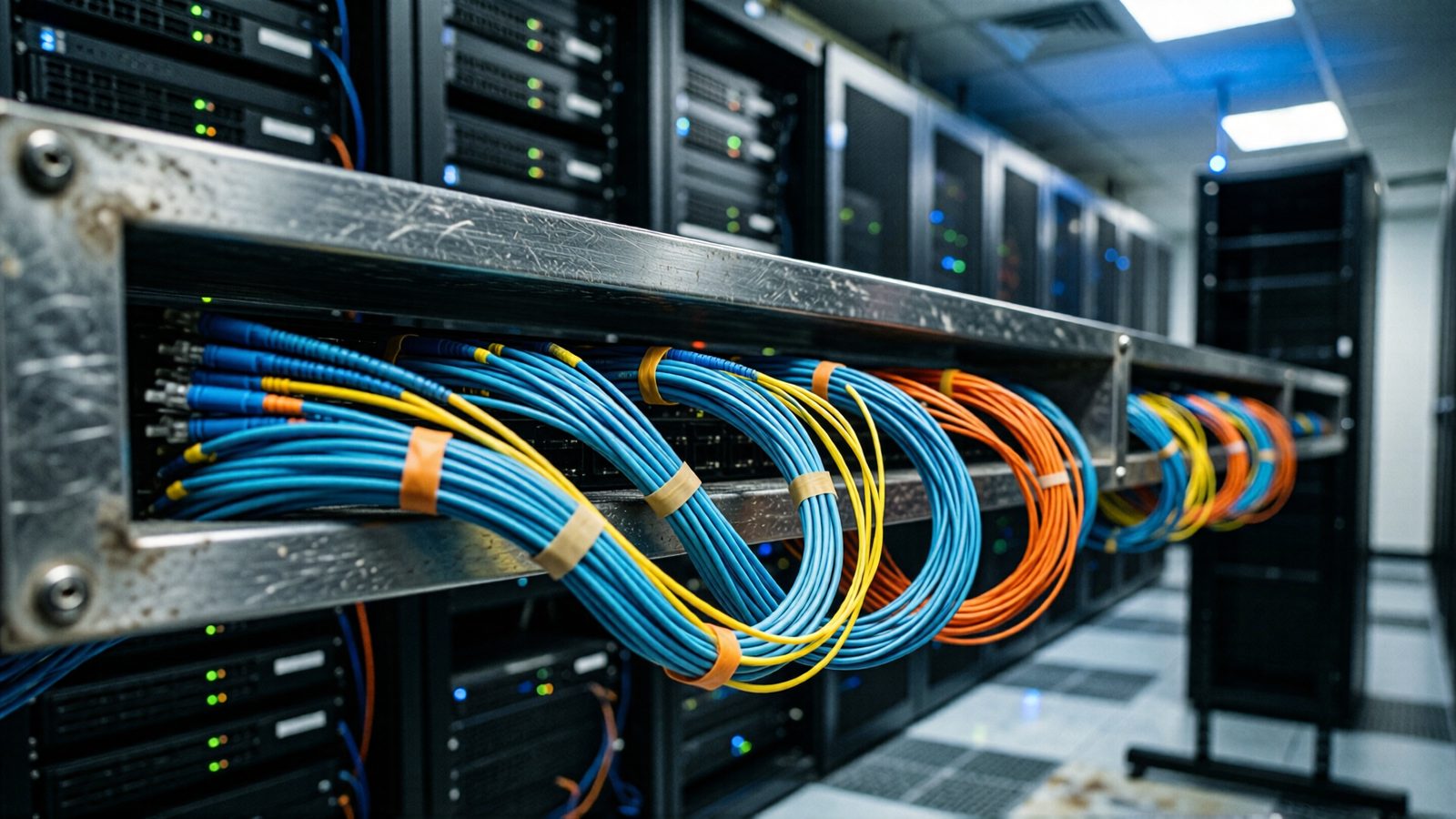
- Never mix ratings within a plenum path. A single non-compliant cable in an air-handling void invalidates the compliance of everything sharing that void in the eyes of the authority having jurisdiction. In practice this is where substitution damage shows up: a technician runs out of plenum patch cords and finishes the last three cabinets from a box of general-purpose cords.
- Separate the cable rating from the penetration seal. Passing through a rated wall or floor requires a tested firestop system, evaluated under ASTM E814 or an equivalent method, that is appropriate for the cable type and the bundle size. A plenum cable through an unsealed penetration is still a code violation. The seal and the jacket are two different products with two different test reports.
- Control fill and bundling. Flame behaviour in a densely filled tray differs from the single-cable test conditions. Keep tray fill within the design limit and within the manufacturer’s recommendation, and avoid compressing bundles with tight ties. Large bundles also trap heat, which shortens cable life in high-density AI cabinets.
- Respect bend radius. Plenum jacket compounds are stiffer, and the temptation to force a tight radius behind a panel is higher. Exceeding the radius does not merely risk attenuation; it can crack a filled jacket and expose the core, which is a physical defect that an inspector may treat as damaged cable.
- Support the pathway properly. Support spacing and tray type belong to the pathway design; wide-span trays that sag under bundle weight create point loads and jacket deformation. Use properly rated tray, basket and vertical managers rather than improvised supports.
For the pathway hardware itself, the practical choices are well covered in the product references for vertical cable managers and horizontal cable managers, and for the distribution point in the optical distribution frame range. These components do not carry a fire class of their own in the same sense as the cable, but they determine whether the installed cable stays within its rated geometry.
11. Cost and lead time: where the premium actually sits
The cost gap between a general-purpose cable and a plenum cable is not marginal, and it is driven by compound price rather than by manufacturing complexity. Fluoropolymer jackets can multiply the jacket cost several times over compared with PVC, and because the jacket is a large share of a small-diameter fiber cable’s material cost, the finished cable price moves accordingly. Riser compound sits between the two. LSZH compounds vary widely with filler loading and are frequently closer to riser pricing than to plenum pricing.
Three procurement behaviours reduce total cost without compromising compliance.
Match the cable to the actual pathway, run by run. Shaft runs, general horizontal runs and plenum runs are different products. Specifying plenum everywhere is safe but expensive; specifying general purpose everywhere is cheap and illegal. A takeoff segmented by pathway type usually recovers most of the premium.
Buy pre-terminated assemblies with the rating documented at assembly level. Factory terminations reduce field labour and, more importantly, come with an assembly-level test record. The trade-off is lead time, and the comparison between factory and field termination is set out in pre-terminated versus field-terminated cabling: cost and lead time. For high-density trunk builds, the assemblies referenced under multi-fiber pre-terminated and MTP/MPO assemblies are the usual starting point.
Do not let lead time force a substitution at the end of a fit-out. Plenum and B2ca materials are stocked less deeply than commodity cable, and a shortage late in a project is the single most common reason a non-compliant cable ends up installed. Order the rated cable with the first release of material, not the last.
12. Procurement checklist: what to demand from a supplier
Every item below should be satisfiable before a purchase order is released. A supplier who cannot answer these questions is not necessarily non-compliant, but the burden of proof is on the product, not on the buyer.
| Item | What to request | Why it matters |
|---|---|---|
| Jacket print legend | Photo or drawing of the exact legend, showing the type letter (OFNP, OFNR, OFNG) or CPR class | The legend is what the inspector reads; marketing literature is not evidence |
| Third-party listing | Listing or verification reference from a recognised body for the specific construction | Self-declared test data is weaker than a listed product file |
| Test reports | NFPA 262 or UL 1666 report for North America; EN 50575 test reports for the EU class | Confirms the claimed rating applies to this construction, not a sister product |
| Declaration of Performance | DoP with the full class string including smoke, droplet and acidity suffixes | Legally required for EU building installation; defines what was actually declared |
| Compound statement | Written statement of jacket and buffer material family, and halogen content status | Plenum does not imply halogen free; the two requirements must both be stated |
| IEC evidence for LSZH claims | IEC 60754-1, 60754-2 and 61034-2 results with thresholds | Prevents “LSZH” from being an unverified adjective |
| Assembly-level documentation | For pre-terminated cords and trunks, the rating and test record for the finished assembly | The assembly, not the bulk cable, is what gets installed and inspected |
| Batch traceability | Reel and lot identification linking delivered goods to the tested construction | Supports audit and defends against undocumented substitution |
| Certification transferability | Confirmation that the rating applies to the exact fiber type, count and jacket thickness ordered | Ratings attach to constructions; a 24-fiber and a 144-fiber cable are different products |
| Environmental compliance | RoHS and REACH statements | Separate from fire performance but part of the same product file |
13. Field verification checklist
Compliance is decided on site, and a short inspection routine catches nearly every failure mode.
- Walk the plenum and shaft routes and read the print legend on the cable actually installed, not the carton label. Check both ends of long runs, since a mid-run splice or a pulled-in substitute is not visible from the tray.
- Confirm that no general-purpose or riser-only cable appears in an air-handling void, including short jumper lengths between cabinets and any cable added after the original installation.
- Verify that every rated wall and floor penetration has a firestop system with documentation, and that the system is rated for the cable type and bundle size present.
- Check tray fill and support spacing against the design, and inspect for crushed or kinked jackets at tight radii, especially behind patch panels where stiffer plenum jackets resist bending.
- Confirm labeling and administration records so that a future move, add or change does not introduce an unrated cable into a rated pathway. Structured labeling discipline is set out in the guides on fiber polarity methods A, B and C and, for the physical layer, in the fiber patch cord selection guide.
- Record the delivered ratings, DoP references and firestop documentation in the as-built package; the next tenant improvement project will need them.
14. Six mistakes that recur on real projects
Treating LSZH as a global rating. It is a materials and IEC performance description. In North America it does not satisfy a plenum requirement, and in the EU the legal instrument is the CPR class, not the phrase.
Assuming plenum means halogen free. Fluoropolymer plenum jackets contain fluorine. Where both properties are needed, both must be specified and both must be evidenced.
Running riser cable into the ceiling void. The two ratings are not interchangeable in the permissive direction. Plenum may go in a riser; riser may not go in a plenum.
Ignoring the conductive variant. OFCP and OFCR contain metallic members and trigger bonding and grounding requirements. Dielectric OFNP is often simpler to deploy and easier to justify in high-density cabinets.
Specifying a CPR class without suffixes. A bare “Cca” leaves smoke, droplets and acidity undefined, which is exactly the space a substitution will exploit.
Buying assemblies without assembly-level documentation. The bulk cable may be fully compliant while the delivered cord or trunk carries no declared rating, which is a documentation failure discovered at the worst possible moment.
15. Questions that come up in every specification review
Can a plenum cable be used in a riser? Yes. Plenum ratings are the most permissive indoor classification in the NEC system and are accepted in risers and general-purpose spaces, at a cost premium.
Is a B2ca cable automatically acceptable in a US plenum? No. The CPR class is a European declared performance; a North American authority will look for an NFPA 262 based type letter. Dual-rated products exist and are the practical answer for multinational specifications.
Does a higher IEC category replace NFPA 262? No. The tests differ in geometry, airflow and what they measure. Higher IEC bunched-cable categories indicate better behaviour in a vertical tray fire; they do not demonstrate performance in a horizontal air-handling tunnel.
Where does the smoke requirement come from in a data hall? From life safety and asset protection. Even where the legal minimum is a moderate class, high-value electronics justify a low-smoke, low-acidity specification, because acid gas damage to equipment extends far beyond the fire zone.
Does the rating apply to patch cords? Yes. Patch cords installed in a plenum must themselves be plenum rated, and cords are the most frequently substituted item because they are bought in bulk and handled by many people. Ordering rated cords alongside the rated bulk cable, in the same release, removes the temptation.
For the connectors and cords themselves, the jacket options and their implications are covered in the fiber pigtail selection guide on buffered fiber, connector and jacket choices. For copper-side parallel requirements, the Cat6A unshielded patch cord with LSZH jacket and the indoor butterfly LSZH drop cable illustrate how the same LSZH chemistry is applied to different product families.
16. How the rating interacts with the rest of the optical design
Fire rating sits inside a larger design stack, and it is worth confirming that the rated product can still meet the optical requirement. Stiffer plenum jackets impose larger minimum bend radii, which consumes slack space in cabinets and trays and can force longer routing. Larger jacket diameters reduce the number of cords that fit in a given manager. Neither effect changes loss budget directly, but both change installability, and installability problems become attenuation problems when a technician forces a bend.
Two cross-checks are worth running at design stage. First, confirm the strand count and connector density still fit the physical space once the rated jacket dimensions are used, using the method in the AI rack fiber strand count calculation guide together with the panel references under the GPX70 fiber patch panel and the GPX58 modular patch panel. Second, recompute the link loss with the actual cord and trunk constructions specified, following the optical loss budget calculation guide, and confirm that the extra patch points introduced by rated assemblies do not erode margin.
Where trunks are used to reduce connector count, the rules for fiber count, lane mapping and polarity in the MPO/MTP trunk cable guide apply unchanged, but the trunk’s jacket rating must be confirmed for every space it passes through. A single trunk crossing from a riser into a plenum ceiling is, for code purposes, a plenum installation for that segment. Terminations should also be inspected and cleaned to the standard described in the endface cleaning and inspection guide before the pathway is closed up, since working in a plenum above a suspended ceiling is far harder after the fact.
17. Conclusion: specify three things, not one
The plenum, riser and LSZH question resolves cleanly once the three vocabularies are kept apart. Plenum and riser are pathway ratings defined by NFPA 262 and UL 1666 and enforced through NEC type letters. LSZH is a materials and IEC performance description, legally expressed in Europe through a CPR class and a Declaration of Performance. A specification that names all three — pathway rating by space, IEC evidence for low smoke and low halogen, and a full CPR class string where the EU applies — closes the gaps that substitutions exploit.
The practical sequence is short. Map the pathway, because the space dictates the rating and nothing else does. Write the rating into the bill of materials as a product attribute, not a note. Require the evidence before the order is released: print legend, listing, test reports, DoP, and assembly-level documentation for anything factory terminated. Then inspect the print legend on installed cable, because the only rating that counts is the one in the ceiling.
Every year of delay in getting this right is expensive in a different currency: re-pulling cable above a live data hall, re-inspecting a shaft, or explaining to an authority why the last three cabinets used a different cord. Getting the jacket right at the specification stage costs a fraction of that, and it is one of the few decisions in a fiber project that is genuinely settled once and never revisited.