

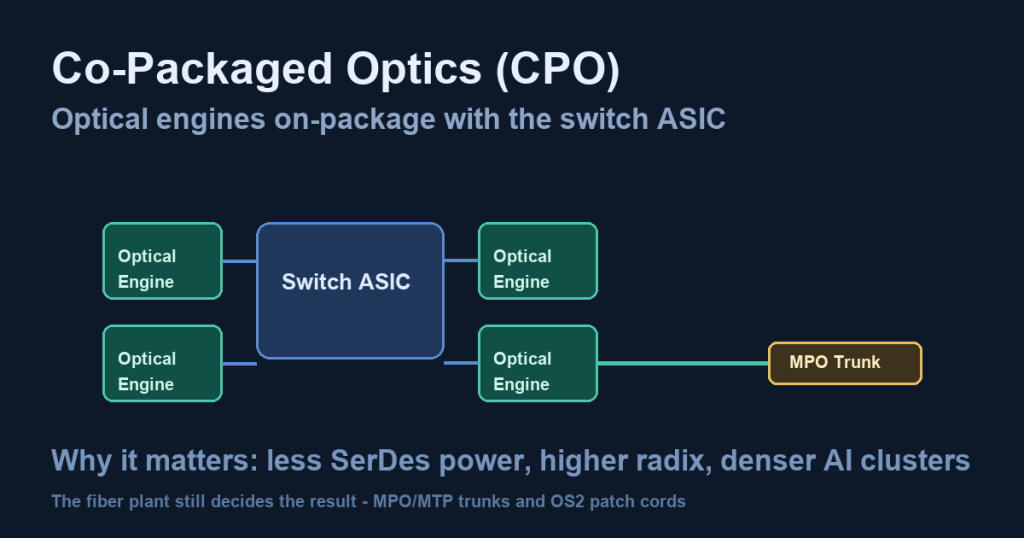
Short answer: The co-packaged optics (CPO) market in 2026 is shifting from engineering samples into early production, driven by AI clusters that push switch bandwidth beyond what front-panel pluggable transceivers can deliver economically. While CPO changes where the optical engine sits, it does not change the physics of the fiber plant — trunk cables, MPO/MTP connectivity, and single-mode patch cords still determine whether a CPO-based system delivers its promised power and density gains, which is why ADTEK keeps this guide updated alongside its high-density cabling portfolio.
What Is Co-Packaged Optics?
Co-packaged optics places the optical engine — laser, modulator, photodetector, and driver circuitry — on the same package or substrate as the switch ASIC, instead of in a pluggable module on the front panel. The electrical signal travels only a short distance from the ASIC to the optical engine, avoiding the power-hungry SerDes links, retimers, and high-speed PCB traces that pluggable architectures require.
The result is a step change in three areas:
- Power efficiency: eliminating long electrical paths removes a large share of the energy consumed by high-speed SerDes links.
- Density: the switch front panel is freed from the physical size of pluggable cages, allowing more radix per rack unit.
- Bandwidth scaling: optical engines can be co-packaged around the ASIC in arrays, scaling aggregate bandwidth beyond what a faceplate can hold.
For a broader view of how hyperscale demand is reshaping the optical market, see our article on how AI demand is transforming the optical communications market.
Why 2026 Is the Turning Point
CPO has been discussed for years, but 2026 is the first year where the economic case is being tested at scale. Three forces converge:
| Force | Impact |
|---|---|
| AI cluster scale-out | GPU back-end networks need hundreds of thousands of 800G and 1.6T ports; pluggable density and power budgets become limiting factors |
| SerDes power wall | Each additional electrical hop adds measurable watts per bit; co-packaging removes several hops |
| Ecosystem maturity | Silicon photonics, laser attach, and automated fiber coupling have reached production yield levels that make CPO manufacturable |
The industry is not abandoning pluggables — 800G and 1.6T pluggables remain the mainstream for the next few years. CPO in 2026 is best understood as the leading edge of the same trend: moving optics closer to the switch silicon to save power.
Market Predictions for 2026 and Beyond
- Early production, not mass adoption: expect CPO switches in selected hyperscale clusters and co-packaged optical engines in AI accelerators, while pluggables continue to dominate general data centers.
- 1.6T and beyond: CPO shines where aggregate port count and power matter most, making 1.6T the natural proving ground for co-packaged engines.
- Standardization advances: OIF and COBO-style specifications will converge further, reducing the ecosystem fragmentation that slowed earlier adoption.
- Supply chain consolidation: laser suppliers, silicon photonics fabs, and connector vendors will form tighter partnerships to control yield and cost.
What CPO Means for Your Fiber Plant
CPO changes the transceiver, not the cabling rules. Optical engines still connect to the network through fiber, and the density gains of CPO increase the importance of structured, high-density cabling:
- MPO/MTP trunk cables move the highest-density traffic between switches and patch panels — see our fiber trunk patch cords range and the MTP trunk patch cords rated for 100G/400G.
- Single-mode fiber becomes the default for CPO-scale links; our OS2 single-mode patch cords support the longest reach and cleanest upgrade path.
- Breakout and polarity management matter more as port density rises — breakout patch cords bridge high-density trunks to low-port-count optics.
Whether the optical engine sits on the front panel or inside the switch package, the cable plant remains the physical foundation of every AI data center network.
Frequently Asked Questions
What is co-packaged optics (CPO)?
Co-packaged optics places optical engines on the same package as the switch ASIC, replacing front-panel pluggable transceivers with tightly coupled optical engines to save power and increase bandwidth density.
Will CPO replace pluggable transceivers in 2026?
Not yet. Pluggable 800G and 1.6T modules remain the mainstream. CPO enters early production in selected hyperscale deployments, with broader adoption expected as standards mature and costs fall.
Why does CPO matter for AI data centers?
AI back-end networks consume enormous power at the electrical layer. CPO removes several high-speed electrical hops, cutting per-bit power and enabling higher radix switches in the same rack footprint.
Does CPO change cabling requirements?
The transceiver changes, but the fiber plant does not. High-density MPO/MTP trunks, single-mode patch cords, and careful polarity and breakout management remain essential — in many cases more so, because CPO raises port density.
What should network managers do today?
Design the cable plant for high density and single-mode readiness: use MPO/MTP trunks, OS2 patch cords, and structured breakout, so the network can absorb CPO-scale optics without a cabling overhaul.