

Why OXC Architecture Matters in AI Data Center Networks
AI clusters now scale to thousands of GPUs, and the optical fabric connecting them has become as important as the compute itself. The optical cross-connect (OXC) offers a way to route high-speed signals entirely in the optical domain — no optics-to-electronics conversion, no protocol rewrites, no manual re-patching. This article explains the architecture behind OXC, where it fits in a modern data center, and why passive optical switching is gaining attention as 800G and 1.6T lanes reshape the network.
What an Optical Cross-Connect Actually Does
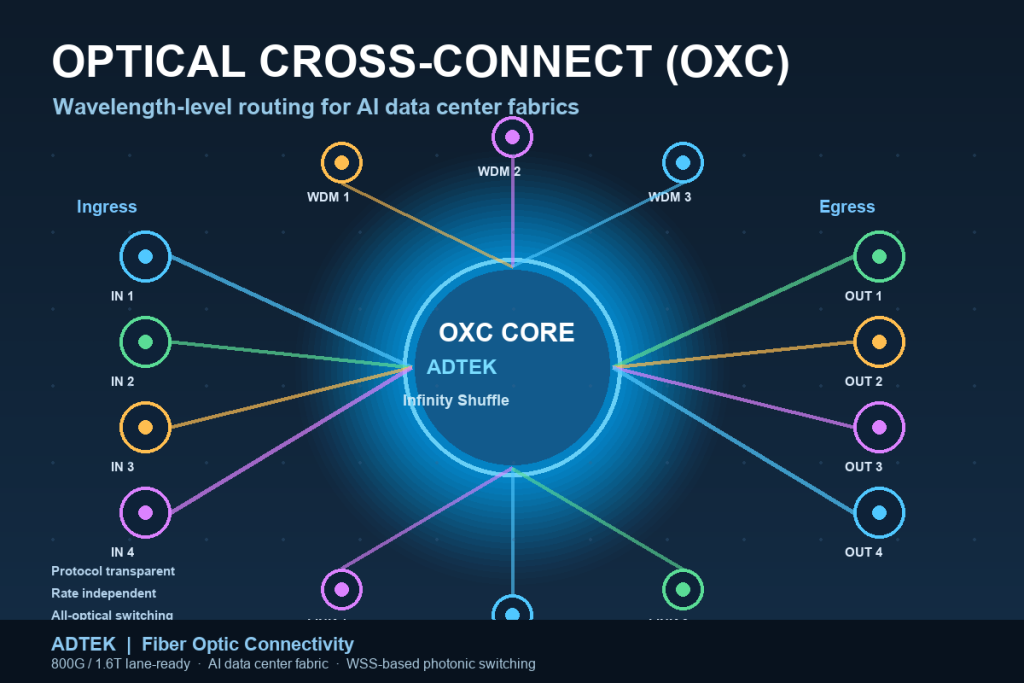
An optical cross-connect is a network element that switches optical signals between fiber inputs and outputs without converting them to electrical signals. The signal path stays transparent: wavelength channels are demultiplexed from incoming WDM signals, routed through a photonic switch matrix, and re-multiplexed onto outgoing fibers. Because the switching happens in the optical domain, the OXC preserves data-rate and protocol transparency — the same fabric can carry 100G, 400G, 800G or 1.6T circuits without change.
Control is electronic. An SDN controller or management plane can dynamically allocate bandwidth and restore paths without manual patching, which is why OXCs are used both in telecom backbone meshes and in data-center interconnect layers where reconfiguration speed matters.
OXC vs. Active Switching: What Changes at High Lane Counts
| Factor | Active switch fabric | Passive OXC (photonic switching) |
|---|---|---|
| Signal path | O-E-O conversion per port | All-optical, protocol transparent |
| Power draw | Scales with port count and speed | Near-zero per lane |
| Lane rates | Fixed by transceiver electronics | Independent of data rate |
| Failure behavior | Port or module failure can stop the flow | Lane-level redistribution possible |
| Best fit | Packet-level switching, oversubscription control | Circuit-level routing, WDM trunks, AI rail fabrics |
OXC does not replace the switch fabric for packet processing — it complements it by handling the optical circuit layer, so switches spend their capacity on actual forwarding instead of managing long-haul fiber paths.
Where OXC Fits in Leaf-Spine Data Center Networks
In a leaf-spine DCN, the spine layer is the natural home for an optical cross-connect layer. Instead of dedicating a fixed set of fibers to each leaf-spine pair, an OXC allows wavelengths and fiber pairs to be provisioned dynamically between any leaf and any spine port. This improves utilization of expensive transceivers and fiber infrastructure, and it shortens the time to bring up new connectivity when workloads move.
The same principle applies between data center sites: an OXC can interconnect multiple facilities with many wavelengths of 100–400G signals, supporting cloud and HPC applications that need predictable low-latency optical circuits.
Graceful Degradation: The Reliability Story for AI Fabrics
In a standard link-to-link AI fabric, one failed transceiver can halt an entire training job. A passive OXC with rail-optimized lane distribution changes that: when a transceiver fails, the affected lanes are redistributed across independent paths, turning a catastrophic link failure into a manageable bandwidth reduction. The cluster keeps training, and the network degrades gracefully instead of stopping hard. This design principle — graceful degradation, built in — is what makes OXC architecture attractive for large GPU clusters that cannot afford job restarts.
How ADTEK Builds OXC Solutions
ADTEK’s Infinity Shuffle OXC brings this architecture to production data centers with Flex Shuffle and Flexless Shuffle variants, distributing 800G and 1.6T lanes across independent paths to protect AI fabrics from single-point failures. The OXC portfolio builds on ADTEK’s core optical connectivity products: MTP/MPO assemblies and pre-terminated trunks for high-density parallel optics, patch panels and ODFs for structured fiber management, and WDM modules for wavelength-level routing. Because the full signal chain is factory-engineered and pre-terminated, deployment time drops and field error rates stay low.
Frequently Asked Questions
Is an OXC the same as a fiber patch panel?
No. A patch panel is a passive physical interconnect point; an OXC adds a photonic switch matrix that lets operators re-route wavelengths and fiber paths under software control, without touching the patch cords.
Does OXC switching add latency to the optical path?
Because the signal stays in the optical domain and no electrical conversion happens, the added latency is negligible compared with O-E-O switching — a key reason OXC is considered for AI fabrics and HPC interconnect.
Can an OXC carry different data rates on the same fiber plant?
Yes. OXC switching is protocol- and rate-transparent, so the same fabric can carry 100G, 400G, 800G or 1.6T circuits, which simplifies network evolution as line rates increase.