

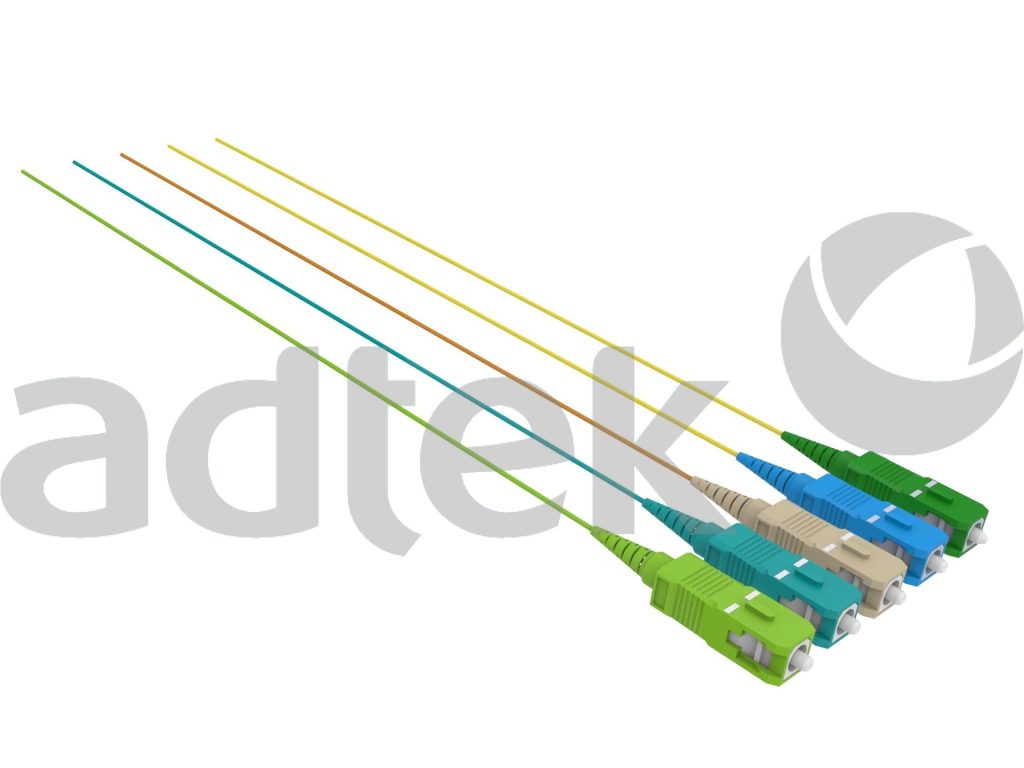
Short answer: To choose a fiber pigtail, match four things: fiber mode (single-mode 9/125 µm vs multi-mode), buffered fiber size (600 µm vs 900 µm) and buffer style (easy strip, semi-tight, or tight buffer), connector type (SC, LC, FC, or ST), and jacket material (PVC, LSZH, or Hytrel) for the environment. Confirm the pigtail meets the required performance grade (Grade B/C/D) and IEC requirements before splicing.
Why Fiber Pigtail Selection Matters
A fiber pigtail is a short length of optical fiber terminated with a connector at one end and left bare at the other, ready for fusion or mechanical splicing to a distribution cable. It is the bridge between the outside plant and the equipment, used in ODFs, splice cassettes, patch panels, and wall boxes. Choosing the wrong buffer size, fiber mode, or jacket can create handling problems during splicing, add attenuation in the link, or fail the environmental requirements of the installation.
Step 1: Start with the Fiber Mode
Select pigtails that match the fiber type of the network. Single-mode fiber uses a 9/125 micron core and is the standard for long reach, WDM, and high-speed transport. Multi-mode fiber uses 50/125 or 62.5/125 micron cores and is common in short-reach data center links where parallel optics and VCSEL transceivers are used. ADTEK pigtails support different fiber modes and can be supplied to match the installed cabling; mixing core sizes in a link creates loss at every transition.
Step 2: Choose Buffered Fiber Size and Buffer Style
Buffered fiber diameter affects how easily the pigtail handles inside fiber management (FM) spaces such as ODFs, panels, splice cassettes, and wall boxes:
- 600 µm buffered fiber is lighter and easier to route in tight fiber management areas.
- 900 µm buffered fiber is more robust and easier to handle during installation and maintenance.
Buffer construction also matters for stripping and splicing:
- Easy-strip buffers speed up fusion splicing by simplifying coating removal.
- Semi-tight and tight buffers provide different levels of protection and stiffness for routing and strain relief.
Select the buffer style based on how much handling and routing the pigtail will experience during installation.
Step 3: Select the Connector Type
Match the pigtail connector to the adapters, patch panels, and equipment ports in the network. ADTEK pigtails are available with common connector options including:
- SC connectors, widely used in FTTH, enterprise networks, and patch panels.
- LC connectors, the dominant small duplex type for modern transceivers in data centers.
- FC screw-on connectors for test equipment and legacy telecom installations.
- ST bayonet connectors for legacy LAN and instrumentation applications.
For high-density parallel-optics environments, see our MPO vs MTP guide to understand when trunk-and-cassette architectures replace individual pigtails.
Step 4: Choose Jacket Material for the Environment
Jacket material determines fire safety, mechanical protection, and suitability for indoor or outdoor use:
- PVC jackets are a general-purpose indoor option.
- LSZH (low smoke zero halogen) jackets are required in many public and telecom spaces for reduced smoke and halogen emission in fire conditions.
- Hytrel jackets provide higher mechanical robustness for demanding routing and outdoor-adjacent environments.
ADTEK pigtail materials are compliant with RoHS2, and jackets are available for indoor/outdoor environments as required.
Step 5: Confirm Performance Grade and Standards
Pigtail quality directly affects insertion loss and return loss of the spliced link. ADTEK pigtails conform to (and in parts exceed) IEC performance requirements, and different performance grades (Grade B, Grade C, and Grade D) are available for competitive cost while meeting network specifications. Confirm the grade against the link budget requirements before ordering.
Step 6: Plan for the Application Environment
ADTEK pigtails are suitable for telecom, data center (DC), datacom, FTTX, and CATV networks, and integrate with ODFs, panels, splice cassettes, and wall boxes:
- Telecom networks: fusion-splice pigtails to distribution cables in ODF units for termination and line scheduling.
- Data centers: use pigtails inside splice cassettes and patch panels to transition trunk fibers to connectorized patching points.
- FTTX and CATV: match the pigtail connector (typically SC) to the subscriber-side equipment.
For the panels and frames these pigtails terminate into, see GPX70 modular patch panel, GPX58 modular patch panel, and GPX60 ODF unit. For the patch cords that complete the patching side, use our fiber patch cord selection guide; for splicing and termination loss management, review our fiber optic attenuation guide.
Fiber Pigtail FAQ
What is the difference between 600 µm and 900 µm buffered pigtails?
600 µm buffered fiber is lighter and easier to route in tight fiber management spaces; 900 µm buffered fiber is more robust and easier to handle. Both are available from ADTEK for ease of handling in ODFs, panels, splice cassettes, and wall boxes.
Can pigtails be installed with mechanical splicing?
Yes. ADTEK pigtails are designed for easy fusion or mechanical splicing for on-site installation, depending on the tooling and environment.
What connector options are available for pigtails?
SC, LC, FC, and ST connector options are available for the 0.9 mm buffered type, covering FTTH, enterprise, data center, and legacy telecom interfaces.
Are LSZH pigtails available?
Yes. PVC, LSZH, and Hytrel jackets are optional, and all materials are RoHS2 compliant.
Do pigtails meet industry standards?
ADTEK pigtails conform to (and in parts exceed) IEC performance requirements, with Grade B, Grade C, and Grade D options available for cost optimization.
ADTEK is a high-tech enterprise and a leading OEM manufacturer and exporter of optical fiber communication devices. For the full fiber management portfolio, see pigtail product page, GPX70 modular patch panel, GPX58 modular patch panel, and GPX60 ODF unit.