

Short answer: Choosing an 800G optical module comes down to four decisions: fiber type (single-mode vs multimode), form factor (QSFP-DD vs OSFP), reach class (SR8/DR8/FR4/LR4), and power budget. ADTEK’s practical guide walks through each decision so network engineers can match the module to their switch ports, cabling plant, and cost targets without overpaying for reach they do not need.
Why 800G Matters in 2026
AI training and inference clusters have made 800G the mainstream port speed in hyperscale back-end networks. Four 200G lanes (or eight 100G lanes) per port multiply bandwidth per rack while keeping cabling manageable — but only if the module, the fiber, and the connector ecosystem are chosen together. A module decision made in isolation often forces a costly cabling retrofit later.
Step 1: Single-Mode or Multimode?
| Fiber type | Typical reach | Best for |
|---|---|---|
| Multimode (OM4/OM5) | 100-150 m at 800G | Short intra-rack and row-level links with existing multimode plants |
| Single-mode (OS2) | 500 m – 2 km and beyond | Hyperscale spine-leaf, campus, and future-proofed builds |
For short AI-rack links, multimode keeps optics costs down; for anything that may outgrow a row, single-mode is the safer long-term bet. Browse our OS2 single-mode patch cords and OM5 multimode patch cords to compare the physical layer options.
Step 2: Form Factor — QSFP-DD or OSFP?
- QSFP-DD: the most widely deployed 800G form factor, pin-compatible in many switches, denser per faceplate, and best supported across vendors.
- OSFP: slightly larger with better thermal headroom, preferred for high-power 800G and early 1.6T designs.
Your switch vendor’s port layout is the decisive factor; pick the form factor your switch generation is designed for, not the one with the lower sticker price.
Step 3: Reach Class
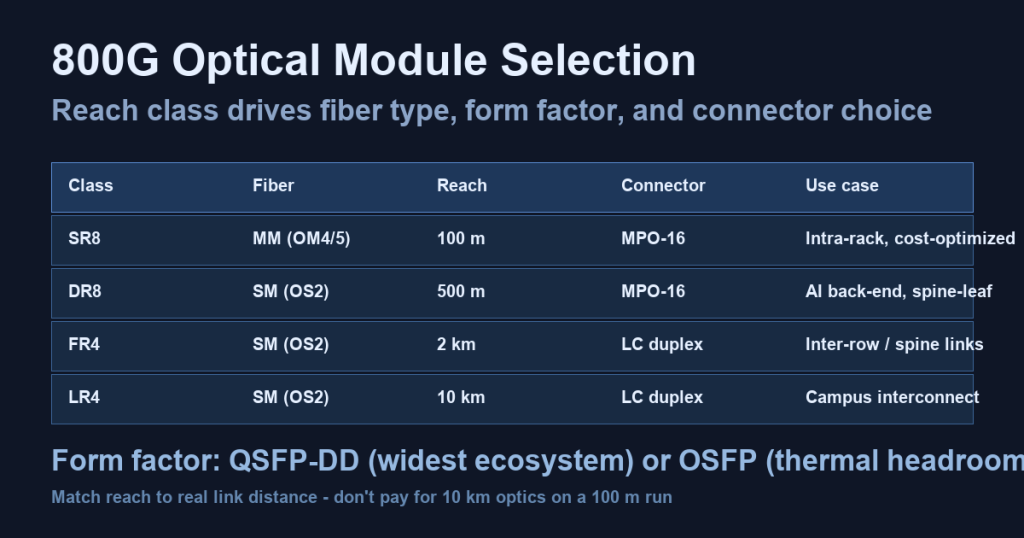
- SR8 (100 m, multimode): cost-optimized short-reach links; eight 100G lanes over MPO-16.
- DR8 (500 m, single-mode): the workhorse for AI back-end networks; eight 100G lanes over MPO-16.
- FR4 (2 km, single-mode): four 200G lanes over duplex LC; good for inter-row and spine links.
- LR4 (10 km, single-mode): campus and inter-building reach at higher cost.
Matching reach class to the actual link distance is where most budgets are wasted — DR8 for a 100-meter run pays for optics you never use.
Step 4: Connector and Cabling Compatibility
800G modules connect through MPO-16, MPO-8, or duplex LC, depending on the reach class. Verify the connector count and polarity against your patch panels before ordering. High-density trunk cables keep the plant clean: see our fiber trunk patch cords and MTP trunk patch cords rated for 100G/400G, which carry the same MPO ecosystem forward to 800G links.
Practical Selection Checklist
- Confirm switch port type and supported form factor (QSFP-DD / OSFP).
- Measure the actual link distance; choose reach class accordingly.
- Count fibers and connector type per link (MPO-16 / MPO-8 / LC duplex).
- Verify polarity and breakout needs before deploying trunks.
- Budget for spare and test cabling — 800G links are less tolerant of dirty or mismatched connectors.
Frequently Asked Questions
What is the difference between 800G SR8, DR8, FR4, and LR4?
They differ by fiber type and reach: SR8 is multimode up to 100 m, DR8 is single-mode up to 500 m, FR4 reaches 2 km over duplex LC, and LR4 reaches 10 km for campus links.
Should I choose QSFP-DD or OSFP for 800G?
Follow the switch vendor’s port design. QSFP-DD offers the widest ecosystem; OSFP provides more thermal headroom for high-power modules and early 1.6T paths.
Does 800G require single-mode fiber?
Not always. Short links can use OM4/OM5 multimode with SR8 optics, but single-mode (OS2) is recommended for anything beyond ~150 m and for future-proofed builds.
What connector does an 800G module use?
It depends on reach class: SR8 and DR8 use MPO-16, FR4 and LR4 use duplex LC. Always verify connector and polarity against your patch panel before deployment.
How much cabling should I plan for an 800G upgrade?
Plan for MPO-16 or LC duplex per port, plus breakout trunks and spare links. Because 800G tolerances are tight, budget for high-quality trunks and clean termination from the start.