
OFC 2025 Insights – 2 :Are we Ready for Hollow Core Fiber Networks?

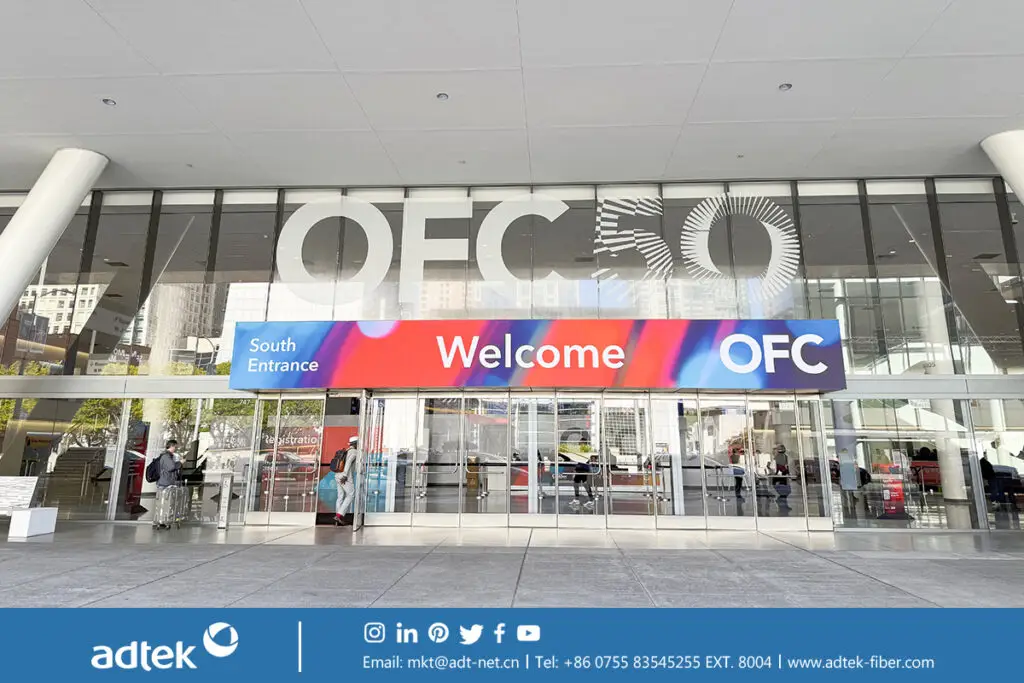
OFC 2025 conference entrance photograph showing the South Entrance of the exhibition venue with large white OFC 50 anniversary logo displayed on glass walls above a vibrant red pink blue gradient Welcome OFC banner people walking through automatic glass doors into the hall and an ADTEK company branded footer banner at the bottom showing adtek logo contact information and social media icons representing optical fiber communication industry trade event

Speakers:

  • Rodrigo Amezcua Correa, Relativity Networks, USA
  • Paolo Dainese, Corning, USA
  • Russell Ellis, Microsoft, United Kingdom
  • Kerrianne Harringtone, University of Bath, United Kingdom
  • Matěj Komanec, CTU, Prague, Czech Republic
  • Andrew Lord, BT, United Kingdom
  • Kazunori Mukasa, Furukawa, Japan
  • Mohammad Pasandi, Ciena, Canada
  • Pierluigi Poggiolini, Politecnico di Torino, Italy
  • Yingying Wang, Linfiber and Jinan University, China
  • YOFC
  • China Telecom
  • Sumitomo (Sato)

HCF Topics:

  • Production Maturity:
  • Advances in DNAN (Nested Anti-Resonant Nodeless) HCF production, enabling longer reach (100km, with potential for 200km). This reflects the growing maturity of HCF manufacturing processes. (Reference: “Recent Progress in Hollow-Core Photonic Crystal Fiber Technology,” Journal of Lightwave Technology: https://ieeexplore.ieee.org/document/9440621)
  • Multi-Core HCF (MC-HCF) development, addressing capacity demands, but also presenting manufacturing and splicing challenges. (Reference: “Space-Division Multiplexing Using Multicore Hollow-Core Fibers,” Journal of Lightwave Technology: https://ieeexplore.ieee.org/document/9121659)
  • Emphasis on scalable and repeatable manufacturing processes, vital for commercial viability.
  • Addressing the complexities inherent in mass production, directly impacting operational costs. (Reference: “Hollow-Core Fiber Market Analysis,” Lightwave Online: https://www.lightwaveonline.com/fiber/article/14287515/hollowcore-fiber-market-analysis)
  • Lack of standardized long lifespan testing: The industry lacks unified standards to test the long term reliability of HCF cables, which is a major issue for large scale deployments.
    • Advantages of HCF:
  • Ultra-Low Latency: Approximately 33% reduction compared to SMF, crucial for latency-sensitive applications like high-frequency trading and 5G/6G networks. (Reference: “Low-Latency Optical Communication Using Hollow-Core Fibers,” Nature Photonics: https://www.nature.com/articles/s41566-020-0610-z)
  • Reduced Nonlinearity: Enables higher power transmission and bi-directional communication, extending reach and improving signal quality. (Reference: “Nonlinear Effects in Hollow-Core Photonic Crystal Fibers,” Optical Fiber Technology: https://www.sciencedirect.com/science/article/abs/pii/S106479981830154X)
  • Increased Bandwidth Capacity: Potential to expand available spectrum, particularly in the 1600nm-1700nm range, addressing future bandwidth demands. (Reference: “Ultra-Wideband Transmission in Hollow-Core Fibers,” Journal of Optical Communications and Networking: https://www.osapublishing.org/jocn/abstract.cfm?uri=jocn-11-1-A12)
  • Lower attenuation: approaching SMF levels.
    • Deployment Challenges:
  • Micro-bend Sensitivity: Larger core diameters (200-250µm) and complex cladding structures necessitate careful handling and deployment.
  • OTDR Limitations: Reduced backscatter and low nonlinearity require specialized OTDR techniques.
  • Environmental Factors: CO2 and H2O absorption within the core impact specific wavelengths, requiring mitigation strategies.
  • Interconnection Complexities: Mode field mismatch between SMF and HCF, contamination concerns, and splicing challenges demand innovative solutions.
  • Cost-Effectiveness: Achieving cost parity with SMF is crucial for widespread adoption.
    • Future Improvements:
  • Ultra-Low Loss Fiber Development: Ongoing research to achieve sub-0.1dB attenuation, enhancing transmission distances.
  • Advanced assemblies Design: Development of assemblies optimized for HCF’s unique properties, including anti-reflective coatings and mode field adapters.
  • Optimized Splicing Techniques: Refinement of splicing methods to minimize losses and ensure reliable connections.
  • Transceiver Compatibility: Development of transceivers capable of fully utilizing HCF’s bandwidth potential.
  • Full Spectrum Utilization: Exploration of the 1650nm-2650nm spectrum, expanding HCF’s application range.
    • Standards:
  • Establishment of comprehensive standards for HCF components, testing procedures, and deployment practices.
  • Standardization of measurement techniques for reliability and lifespan assessment.
  • Development of standardized limits for environmental factors like gas contamination.
  • Standardization of HCF interconnections.

Leave a Reply

Your email address will not be published. Required fields are marked *

Contact US

If you want to know more about us, you can fill out the form to contact us and we will answer your questions at any time.