
VSFF Connectivity: Managing Explosive Fiber Growth at 1.6T and Beyond
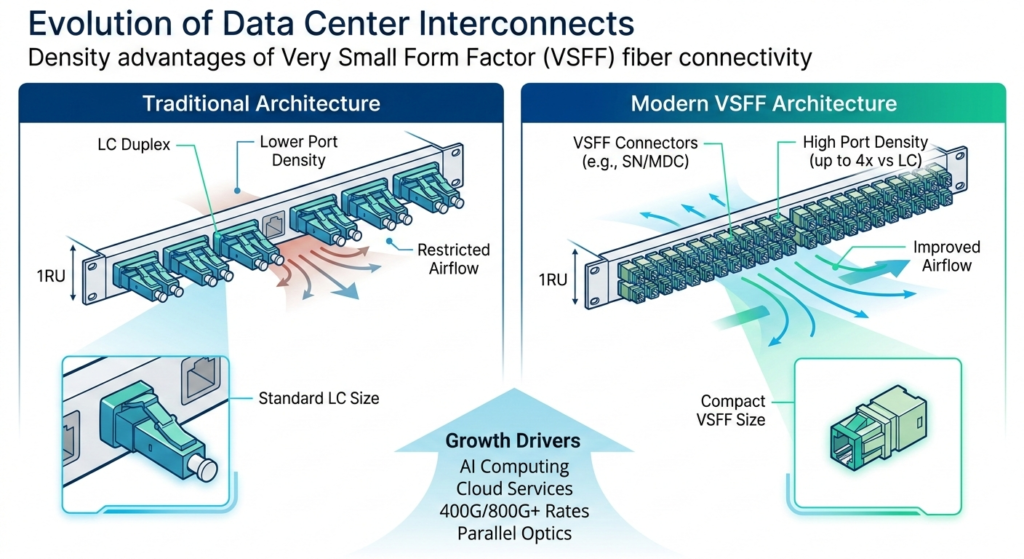
As data centers deploy 1.6Tbps connectivity with 3.2Tbps on the horizon, and switch ASICs drive radix counts to 128 and 144 ports, fiber infrastructure faces an exponential density crisis. VSFF (Very Small Form Factor) connectivity is not about cable reduction—it is about enabling the physical connection of massive fiber counts that legacy interfaces cannot accommodate.
The Density Explosion
Next-generation switches have moved beyond the 32/64-port era. Modern AI-optimized switches deliver 128 to 144 ports of 800G/1.6T, creating a mathematical impossibility: you cannot fit 144 duplex LC assemblies on a 1RU front panel.
Simultaneously, parallel optics architectures dominate 400G/800G/1.6T deployment:
400G: Primarily MPO-8 or MPO-12 (SR8/DR4 variants)
800G: MPO-12 or MPO-16 configurations
1.6T: Emerging MPO-16 and MPO-24 requirements
The result is not fewer fibers, but exponentially more: a 144-port 1.6T switch requires up to 3,456 fibers (MPO-24 × 144). VSFF becomes mandatory not to reduce cable volume, but to fit this fiber explosion into physically available space.
Rack Real Estate Competition
Modern 40-50kW AI racks face a three-way space battle. Fiber connectivity must coexist with:
Power Infrastructure
415V/480V busway taps and PDUs consume 1-2U and significant side-channel space
High-amperage whips (60A-100A+) compete for cable routing paths
A/B redundant feeds double these space requirements
Liquid Cooling Infrastructure
Direct-to-chip manifolds occupy 1-3U per rack
Supply/return lines and quick-disconnects consume side and rear space
CDUs claim 4-6U at rack bases
The Brownfield Reality Legacy facilities cannot expand physical footprints. Fixed 42U/48U cabinets, constrained raised floors, and ceiling heights limit expansion. When power and cooling upgrades consume reserved space, fiber infrastructure must densify into whatever volume remains.
VSFF enables this coexistence by delivering 2-3x the assemblies density in the same footprint, allowing networks to scale despite the fiber count explosion and competing infrastructure claims.
Technical Necessity at 128+ Port Radix
The shift to higher-radix switches (128/144 ports) creates physical constraints that cannot be engineered around with legacy assemblies :
Front-panel geometry: 144 ports × even MPO-12 assemblies exceeds available 1RU width with standard LC/MPO interfaces
Patch panel saturation: Traditional patching architectures collapse under 3,000+ fibers per switch
Serviceability: High port counts require assemblies designs with optimized insertion forces and mechanical stability
At 1.6T, VSFF is not an optimization—it is the only viable physical interface option for high-radix deployment.
Forward to 3.2T
The trajectory toward 3.2T will amplify these constraints:
Higher fiber counts per port: MPO-24 and potentially MPO-32 becoming standard
Port radix expansion: 200+ port switches anticipated for AI fabrics
Co-packaged optics transition: VSFF serves as the external fiber interface for CPO architectures where front-panel space becomes even more constrained
Conclusion
VSFF connectivity addresses the fundamental physics problem of next-generation networking: connecting 128-144 ports requiring 16-24 fibers each into a fixed physical space, while sharing that space with power and cooling infrastructure. Without VSFF-level density, 1.6T and 3.2T switch silicon cannot be deployed—particularly in brownfield environments where rack real estate is already fully allocated to competing infrastructure demands.
If you want to know more about us, you can fill out the form to contact us and we will answer your questions at any time.
We use cookies to improve your experience on our site. By using our site, you consent to cookies.
Manage your cookie preferences below:
Essential cookies enable basic functions and are necessary for the proper function of the website.
These cookies are needed for adding comments on this website.
These cookies are used for managing login functionality on this website.
Statistics cookies collect information anonymously. This information helps us understand how visitors use our website.
Clarity is a web analytics service that tracks and reports website traffic.
Service URL: clarity.microsoft.com (opens in a new window)
Google Analytics is a powerful tool that tracks and analyzes website traffic for informed marketing decisions.
Service URL: policies.google.com (opens in a new window)
Clarity is a web analytics service that tracks and reports website traffic.
Service URL: clarity.microsoft.com (opens in a new window)
You can find more information in our Cookie Policy and Privacy Policy for ADTEK.