
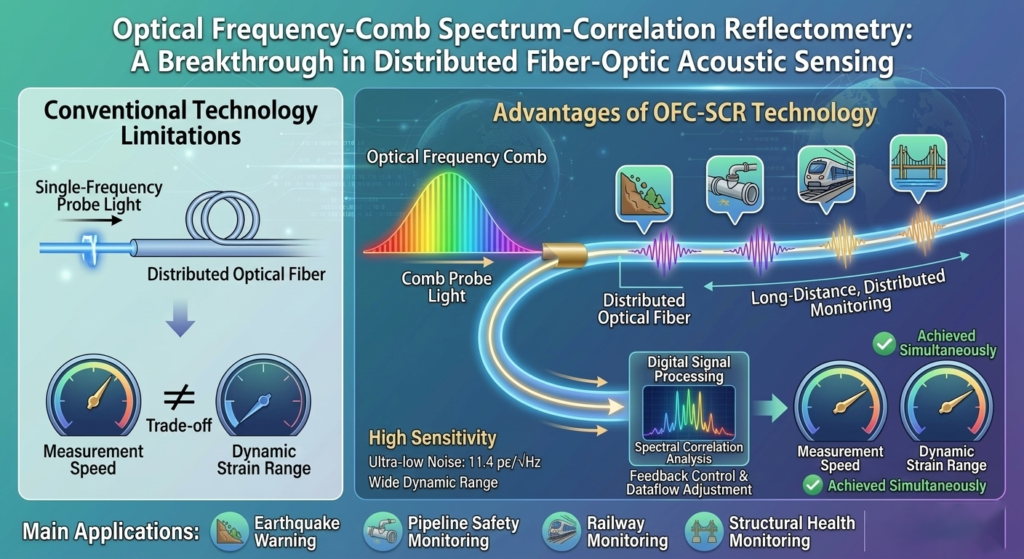
Distributed fiber-optic sensing has become one of the most promising technologies for large-scale monitoring applications, including geohazard early warning, infrastructure safety, and pipeline security. By using the optical fiber itself as a sensing medium, these systems can perform continuous monitoring over tens or even hundreds of kilometers while remaining immune to electromagnetic interference.
Despite these advantages, a fundamental limitation has long restricted the wider application of distributed fiber-optic acoustic sensing: the trade-off between measurement speed and dynamic strain range. Improving one usually comes at the cost of the other, which limits performance in environments where both high sensitivity and fast response are required.
Recently, a research team led by Prof. Ming Tang and Associate Prof. Zhiyong Zhao from Huazhong University of Science and Technology, together with collaborators from Universidad Técnica Federico Santa María in Chile, proposed a new sensing architecture known as Optical Frequency-Comb Spectrum-Correlation Reflectometry (OFC-SCR). Their work, published in Light: Science & Applications, introduces a new measurement paradigm that significantly improves sensing speed while expanding the dynamic strain measurement range, without sacrificing system sensitivity or robustness.
Distributed acoustic sensing (DAS) systems rely on Rayleigh backscattering inside optical fibers. As light travels along the fiber, microscopic refractive-index variations cause a small portion of the signal to scatter backward. By analyzing these backscattered signals, the system can detect vibration or strain changes along the entire length of the fiber.
Because the optical fiber itself acts as a continuous sensing element, this technology enables long-distance distributed monitoring using a single sensing line. Combined with the inherent advantages of optical fiber—such as resistance to electromagnetic interference and the ability to cover large distances—distributed sensing systems have become valuable tools for applications such as:
geological and seismic monitoring
landslide and earthquake early-warning systems
oil and gas pipeline monitoring
railway and transportation infrastructure protection
structural health monitoring of bridges and tunnels

Two major signal processing approaches are commonly used in distributed fiber sensing systems.
The first approach is spectral analysis, which obtains broadband Rayleigh scattering information by performing sequential frequency scanning. While this technique can capture detailed spectral information, the scanning process is relatively slow, making it difficult to detect high-frequency disturbances.
The second approach is phase demodulation, which extracts strain information from phase changes between adjacent measurement points. Although this method can achieve higher measurement speed, the dynamic strain range is limited by the phase accumulation and recovery process.
Because of these limitations, traditional sensing systems must choose between fast measurement speed and wide dynamic strain range, making it difficult to achieve both simultaneously.
To overcome this limitation, the research team introduced a distributed sensing architecture based on optical frequency comb technology.
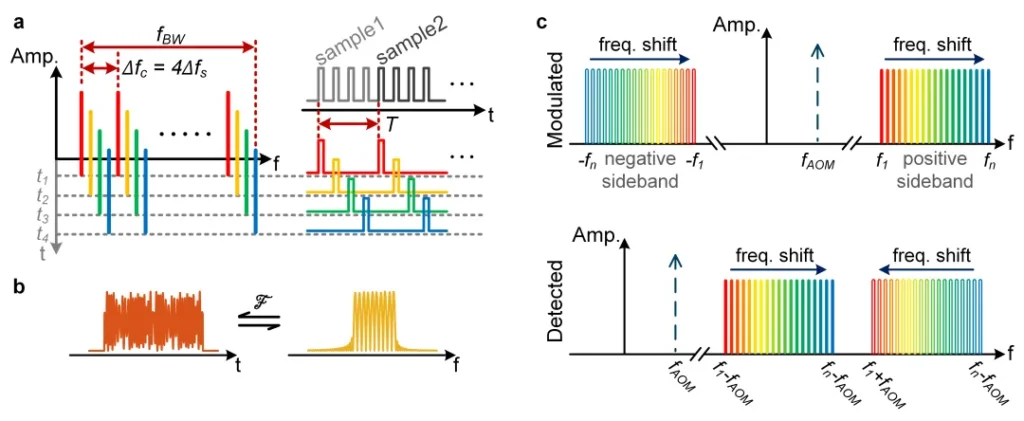
An optical frequency comb consists of a series of evenly spaced and highly coherent spectral lines generated in the digital domain. Compared with conventional single-frequency probe lasers, a frequency comb provides a broadband and highly controllable optical source that can be used to probe the intrinsic Rayleigh scattering spectrum of optical fiber.
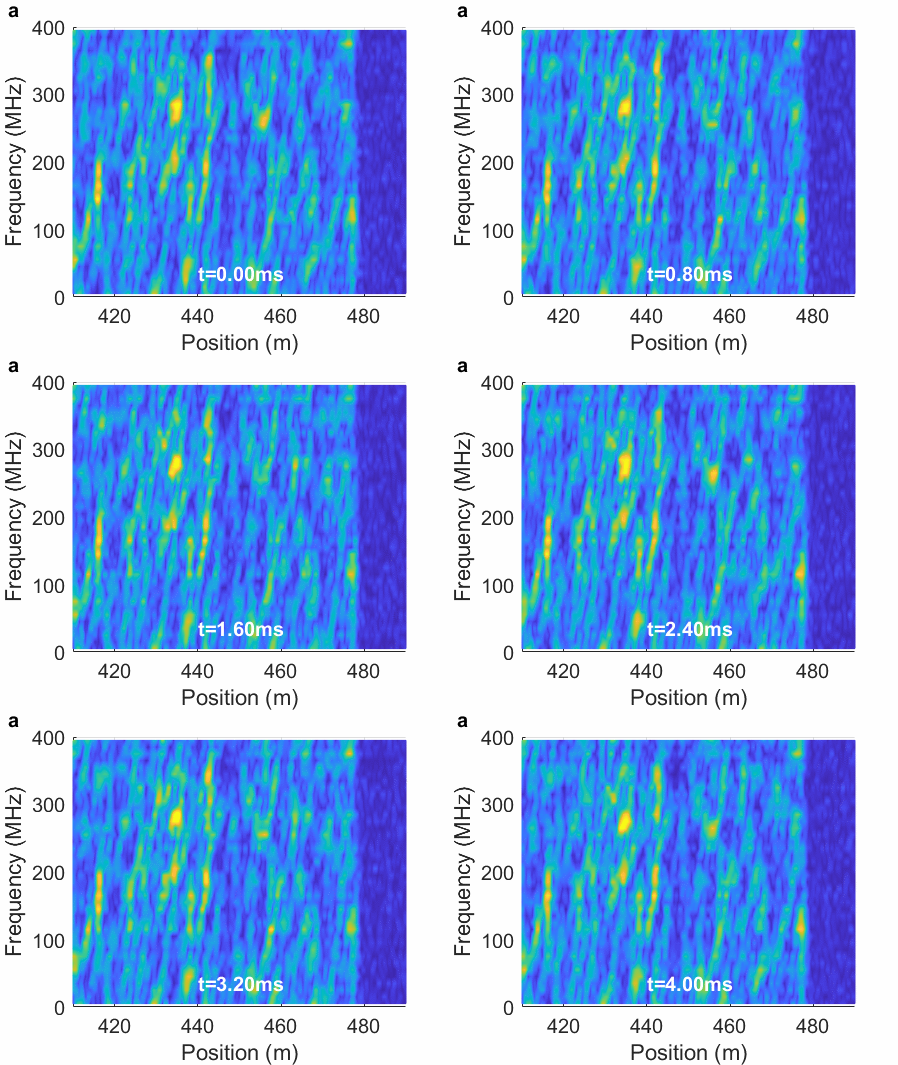
In the OFC-SCR system, frequency-comb probe light replaces the traditional single-frequency source. This allows the system to acquire broadband Rayleigh spectral information simultaneously rather than through sequential scanning.
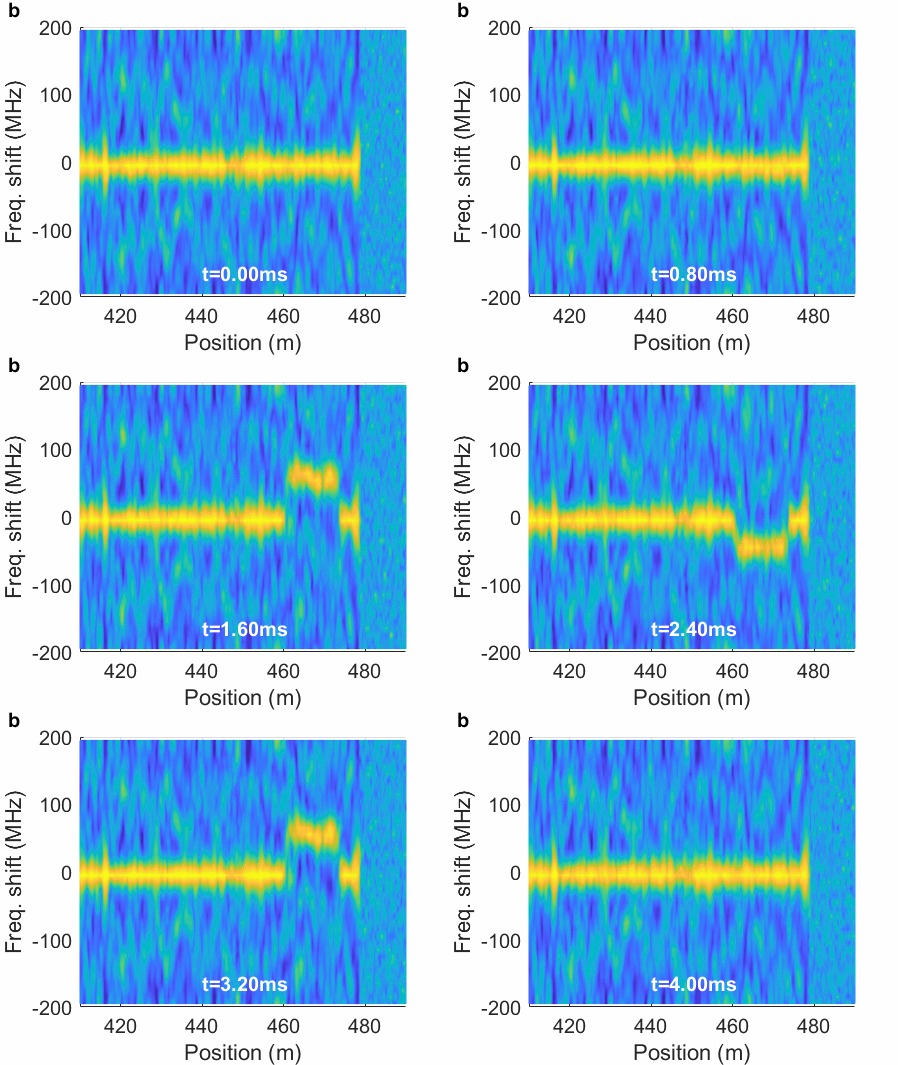
By performing cross-correlation analysis between the measured spectrum and a reference spectrum, the system can extract dynamic strain information with extremely high sensitivity. Because the signal demodulation process does not depend on the continuity between adjacent sampling points, the dynamic strain measurement range is determined by the modulation bandwidth of the frequency comb, rather than by phase-recovery limitations.
This fundamentally changes the sensing mechanism, transforming spectral measurement from a serial scanning process into a parallel detection architecture.
Experimental results demonstrate that the OFC-SCR system significantly improves both frequency response and measurement sensitivity.
Using a sensing system with a frequency comb repetition rate of 50 kHz, researchers successfully detected vibration signals up to 24 kHz, approaching the system’s Nyquist sampling limit of 25 kHz. Under similar bandwidth and frequency-resolution conditions, this represents roughly an order-of-magnitude improvement in frequency response compared with conventional spectral analysis approaches.
At the same time, the system maintains an extremely low noise floor of 11.4 pε/√Hz, showing strong performance in both sensitivity and dynamic response.
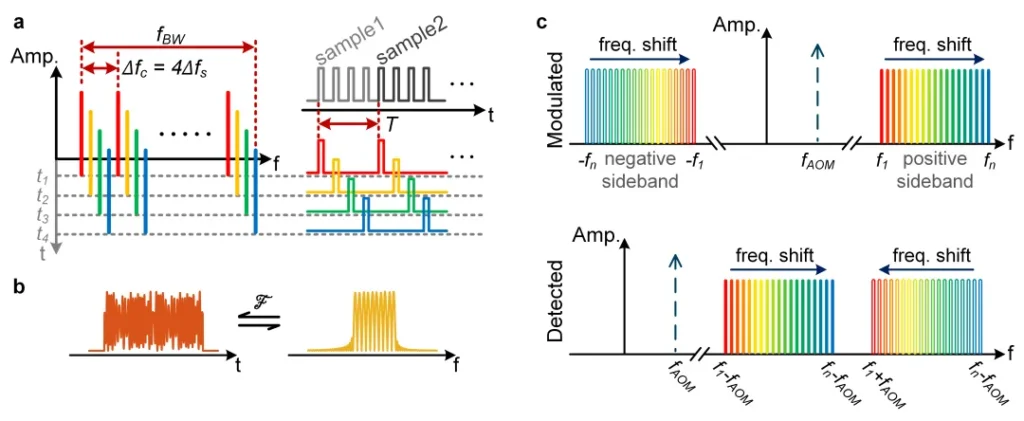
The OFC-SCR architecture demonstrates how frequency-comb parallel probing combined with spectrum-correlation decoding can overcome long-standing limitations in distributed fiber-optic sensing systems.
Instead of relying on sequential spectral scanning, the new approach enables real-time broadband sensing with both high sensitivity and wide dynamic range. As optical frequency comb devices and digital signal processing technologies continue to evolve, this architecture may significantly expand the performance boundaries of distributed sensing systems.
In the future, such technologies could play an important role in large-scale infrastructure monitoring, geophysical exploration, and early-warning systems for natural hazards. As sensing networks become increasingly important in modern infrastructure and environmental monitoring, innovations like OFC-SCR are expected to drive the next generation of distributed fiber-optic sensing solutions.
Lin, Z., Zhao, Z., He, H. et al.
Frequency-comb enabled spectrum-correlation reflectometry for distributed fiber-optic sensing
Light: Science & Applications, 15, 11 (2026)
https://doi.org/10.1038/s41377-025-02080-w