
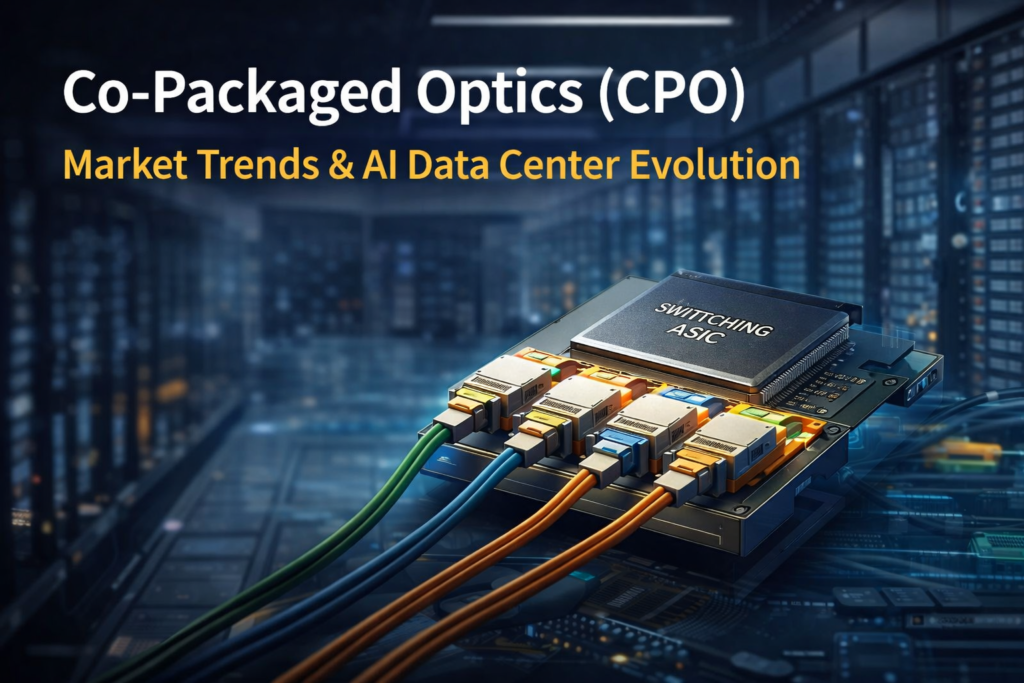
What Is Co-Packaged Optics (CPO)?
Co-Packaged Optics (CPO) is an advanced optical interconnect architecture that integrates optical components—such as photonic integrated circuits (PICs) and lasers—directly alongside switching ASICs or processors within the same package.
This approach significantly reduces electrical I/O distance, enabling lower power consumption, higher bandwidth density, improved signal integrity, and reduced latency.
Compared to traditional pluggable optical modules, CPO shifts optical connectivity from a module-level solution to a chip-level architecture, representing a major evolution in optical communication systems.
Why CPO Matters for AI Data Centers
The rapid expansion of AI infrastructure is pushing data center architectures to their limits. AI clusters require massive data exchange between GPUs, switches, and memory systems, placing unprecedented demands on bandwidth and energy efficiency.
Traditional electrical interconnects are approaching their physical limits, while pluggable optical modules such as 800G and 1.6T are facing increasing challenges in power consumption and thermal management.
In this context, CPO is emerging as a key solution for next-generation AI data centers, enabling higher performance optical interconnect solutions with improved efficiency.
CPO vs Traditional Optical Modules (800G / 1.6T)
CPO represents a fundamental shift compared to traditional pluggable optical modules.
While 800G and 1.6T optical modules are designed as detachable components, CPO integrates optics directly with switching silicon.
Key differences include:
- Shorter electrical paths, resulting in lower power consumption
- Higher integration density for large-scale AI clusters
- Improved signal integrity at ultra-high bandwidth
- Reduced reliance on front-panel pluggable modules
However, pluggable optical modules still offer advantages in flexibility, serviceability, and ecosystem maturity, meaning both architectures will coexist in the coming years.
CPO Market Size and Growth Forecast
The CPO market is currently in an early stage but is experiencing rapid growth.
The global CPO market is expected to grow from USD 95 million in 2025 to over USD 1.05 billion by 2034, with a CAGR of approximately 30.6% (Source: Precedence Research).
Another forecast estimates the market will reach USD 0.84 billion by 2032, growing at a CAGR of 27.5% (Source: Verified Market Research).
These projections reflect strong industry consensus that CPO will become a key enabling technology for next-generation data center interconnects.
Key Technologies Behind CPO
CPO relies on several advanced technologies that enable its performance and scalability.
Silicon Photonics
Silicon photonics provides the foundation for high-density optical integration, enabling scalable manufacturing and reduced cost per bit.
Advanced Packaging
CPO systems depend on advanced packaging technologies such as 2.5D and 3D integration, chiplet architectures, and optical interposers.
These technologies allow the co-integration of electronic and photonic components within a single package.
Optical I/O
CPO is part of a broader transition toward optical I/O architectures, where optical communication replaces electrical interfaces at the chip level.
This enables ultra-high bandwidth and energy-efficient data transmission for AI workloads.
Product Evolution: From Optical Modules to CPO Systems
The emergence of CPO is driving a major transformation in the optical communication industry.
Traditional products:
- Pluggable optical modules (SFP, QSFP, OSFP)
- Co-packaged optical engines
- Integrated optical I/O systems
- System-level optical interconnect platforms
This shift reflects a broader industry trend from discrete components toward integrated data center solutions.
Challenges of CPO Adoption
Despite its advantages, CPO faces several challenges:
- High manufacturing complexity and precision requirements
- Thermal management issues due to proximity to high-power ASICs
- Lack of unified industry standards
- Limited serviceability compared to pluggable modules
Future Outlook of CPO in AI Infrastructure (2026–2030)
CPO is expected to follow a phased adoption path:
Short Term (2026–2027)
Early deployment in hyperscale AI data centers, coexisting with pluggable optics.
Mid Term (2027–2029)
Increased commercialization and integration with silicon photonics platforms.
Long Term (Beyond 2030)
Potential mainstream adoption, with optical I/O becoming a standard architecture.
Frequently Asked Questions About CPO
What is CPO in optical communication?
CPO (Co-Packaged Optics) is a technology that integrates optical components directly with switching chips to improve bandwidth and energy efficiency.
Will CPO replace optical modules?
CPO will not immediately replace pluggable optical modules. Both technologies are expected to coexist.
What are the advantages of CPO?
CPO offers lower power consumption, higher bandwidth density, improved signal integrity, and better scalability for AI data centers.
Conclusion
Co-Packaged Optics represents a fundamental shift in optical communication, moving from modular connectivity toward deeply integrated optoelectronic systems.
As AI infrastructure continues to scale, the demand for high-speed optical connectivity will grow exponentially. CPO is poised to become a key technology enabling the next generation of data center architectures.
Related articles
Share the page:
Contact US
If you want to know more about us, you can fill out the form to contact us and we will answer your questions at any time.