
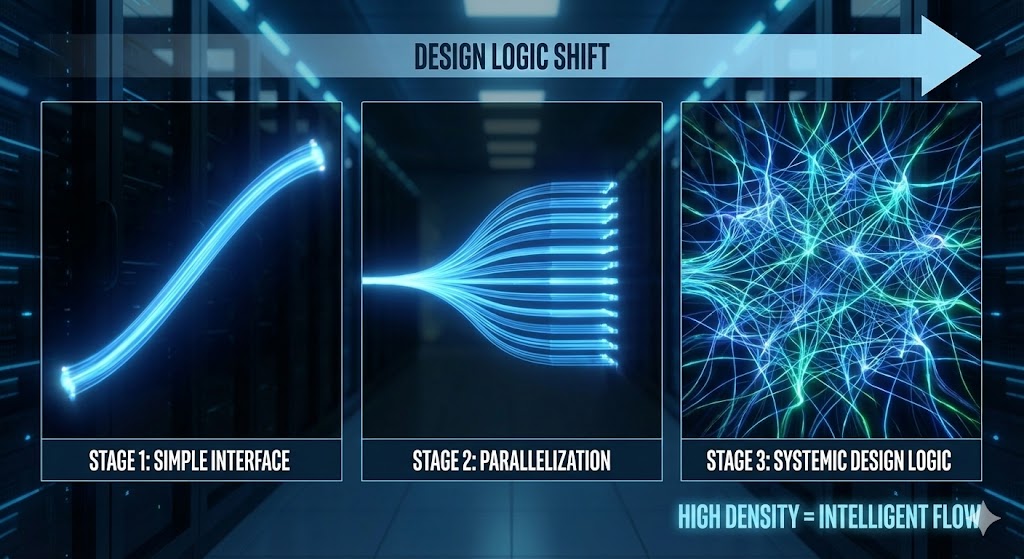
In the evolution of data center networks, changes in assemblies types are often seen as simple interface upgrades.
In reality, the transition from LC to MPO and now to MMC (a VSFF assemblies ) reflects a deeper shift in system design logic, not just assemblies size.
This shift is driven by one key question:
As bandwidth keeps growing, what problem is “high density” really solving in data centers?
During the 10G, 25G, and early 40G periods, LC assemblies were the standard choice in data centers.
Their design logic was straightforward:
One or two fibers per link
Clear one-to-one mapping between ports and transceivers
Simple installation and maintenance
Designed for networks with limited port counts and moderate speeds
At this stage, density mainly meant:
How many LC ports could fit on a switch front panel
How much bandwidth a single rack could support
Connectivity was simple, and fiber management was not yet a major concern.
As 100G and 400G networks became mainstream, network architecture changed:
Parallel optics replaced single-lane transmission
A single port now carried 8, 12, or even 16 fibers
Bandwidth growth depended more on parallel lanes than higher speeds
MPO assemblies enabled this shift, but they also introduced new challenges.
High density was no longer just about ports—it became about:
Total fiber count per rack
Cable size and routing complexity
Polarity, mapping, and planning accuracy
In large-scale deployments, MPO-based systems revealed several limits:
Bulky fiber bundles reduce airflow and make routing difficult
Highly coupled design logic, where small errors affect many links
High operational complexity, especially during moves, adds, and changes
At this point, density stopped being a pure hardware issue.
It became a system-level management problem.
MMC was not designed simply to be a smaller MPO.
Its goal is different: increase usable density while keeping systems manageable.
Key changes in design logic include:
High density now means:
More independent and clearly defined ports
Better port-per-area efficiency
Less reliance on thick, high-fiber cables
MMC allows parallel optics to be broken into smaller, more controlled units:
Easier planning and labeling
Clearer network topology
Better flexibility for future upgrades
Modern data centers—especially those for AI, CPO, and optical switching—require:
Shorter internal links
Better airflow and thermal design
Front-to-back, modular layouts
MMC fits these system-level needs better than traditional multi-fiber assemblies .
When viewed at the system level, high density addresses three core challenges:
Scaling bandwidth in limited physical space
Keeping complex systems serviceable and flexible
Controlling long-term operational cost and risk
From this perspective:
LC focused on simplicity
MPO focused on parallel transmission
MMC focuses on system clarity and long-term operation
The move from LC to MPO to MMC shows that data center connectivity is no longer just about fitting more fibers into smaller spaces.
The real challenge is designing networks that are:
Clear to plan
Easy to maintain
Ready to scale
High density is not the final goal.
A well-managed, future-ready system is.
If you want to know more about us, you can fill out the form to contact us and we will answer your questions at any time.
We use cookies to improve your experience on our site. By using our site, you consent to cookies.
Manage your cookie preferences below:
Essential cookies enable basic functions and are necessary for the proper function of the website.
These cookies are needed for adding comments on this website.
These cookies are used for managing login functionality on this website.
Statistics cookies collect information anonymously. This information helps us understand how visitors use our website.
Clarity is a web analytics service that tracks and reports website traffic.
Service URL: clarity.microsoft.com (opens in a new window)
Google Analytics is a powerful tool that tracks and analyzes website traffic for informed marketing decisions.
Service URL: policies.google.com (opens in a new window)
Clarity is a web analytics service that tracks and reports website traffic.
Service URL: clarity.microsoft.com (opens in a new window)
You can find more information in our Cookie Policy and Privacy Policy for ADTEK.
One Response
The evolution of WDMs and optical cabling is truly fascinating. As we move to 400G and beyond, I can see how important it is to rethink how we design data centers to manage the growing demand for bandwidth efficiently.