
As the industry accelerates toward AI-native architectures, the boundaries of optical interconnect technology are being pushed harder than ever. From Co-Packaged Optics (CPO) to Optical Cross-Connects (OXC), ROADMs, and all-optical switching, the common challenge has become clear:
How do we scale optical connectivity to thousands of fibers while reducing latency, power consumption, and operational complexity?
Infinity Flex Modules—high-density optical shuffle circuits—emerge as a foundational enabler for this transition. But before understanding the role of such modules, it is important to acknowledge the technical bottlenecks facing the next generation of optical systems, especially CPO/NPO.
CPO is a technology with enormous promise, but its implementation introduces several engineering obstacles:
A single CPO ASIC may require:
256–1024 optical channels,
each carrying 100–200 Gbps,
translating into hundreds of ribbon fibers leaving the package.
Managing this density in a 2RU–3RU server environment is extremely challenging.
CPO places optical engines only millimeters from hot ASICs:
ASICs now exceed 800–1200 W per device
Cooling airflow must remain unobstructed
Traditional fiber bundles block airflow and worsen thermal hotspots
This is one of the biggest barriers to CPO commercialization.
Unlike pluggables:
The optical engine cannot be removed if it fails
Fiber routing mistakes are nearly impossible to correct due to space
Vendors require a way to separate active and passive testing
This has led to deep concerns from hyperscalers regarding repair logistics.
CPO ecosystems involve multiple players:
ASIC vendor
Optical engine vendor
Fiber assembly vendor
Interoperability cannot scale without standardized, modular passive pathways.
The transition to:
VSFF (MMC, MDC, SN-MT) assemblies
High-density MPO/MTP
creates uncertainty in system architecture and demands extreme routing precision.
Infinity Flex Modules exist precisely to resolve these scaling issues.
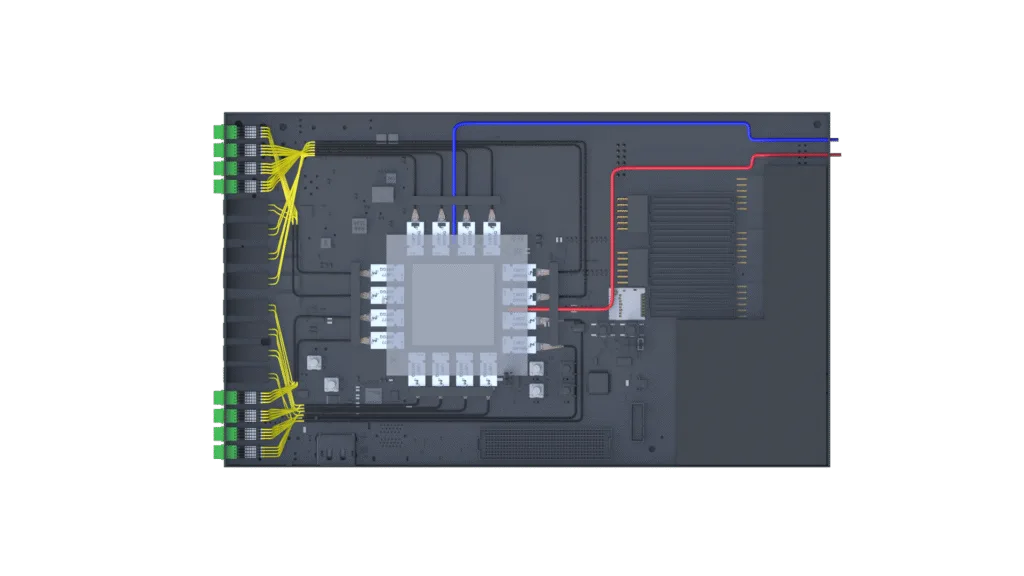
1. CPO/NPO Application: High-Density Fiber Shuffle Inside Servers & Switches
The move toward 50+ Tbps switch ASICs has made traditional fiber harnesses unmanageable. Inside a 2RU/3RU switch, space is consumed by hundreds of fibers connecting the ASIC-side optical engines to front-panel assemblies .
Infinity Flex Modules act as the structural backbone of CPO fiber management:
Replace bulky fiber bundles with a 1 mm–level ultra-thin optical flex circuit
Route fibers from FA/MT chip-level assemblies to front-panel MPO/MTP, LC, or VSFF ports
Maintain bend-loss control, minimize crosstalk, and preserve uniform optical paths
Enable active/passive segregation for troubleshooting and assembly
Improve airflow and reduce obstruction for thermal management
In short, the module transforms a chaotic fiber environment into a planned optical interconnect layer, ensuring that CPO performance and density targets can actually be achieved.
AI and hyperscale cloud networks are adopting optical cross-connects (OXC) to eliminate the operational complexity of traditional electrical switching. However, the internal architecture of OXCs is extremely fiber-dense—often requiring:
Tens of thousands of optical connections
Highly structured wavelength routing
Zero-touch patching and minimal manual operations
Infinity Flex Modules reduce OXC deployment and O&M complexity by:
Consolidating hundreds of fiber runs into one pre-engineered assembly
Eliminating human patching errors (a leading cause of OXC failures)
Reducing the quantity of switch ports, patch panels, rack units, lowering CAPEX
Supporting multiple assemblies ecosystems: MPO/MTP, MMC, SN-MT
Providing a deterministic pathway for internal wavelength routing
This enables OXCs to scale with modern leaf-spine networks while maintaining the flexibility required for AI/ML traffic patterns.
ROADMs are critical for today’s adaptive FTTx/telecom networks, enabling operators to reassign wavelengths without sending technicians to the field.
However, ROADM internals require:
Complex multi-direction ingress/egress mixing
Dense assemblies environments (LC, SC, MPO)
Predictable internal routing with minimal insertion loss
Infinity Flex Modules simplify these architectures:
Replace manually patched fiber with a single optical backplane
Reduce routing errors and mis-patching in wavelength mixing
Provide consistent optical performance across all fiber paths
Support both telecom-grade assemblies and metro-ROADM configurations
The result is a ROADM platform with lower truck-roll costs, higher reliability, and greater operational agility.
Optical Circuit Switches (OCS) are becoming essential for AI clusters due to their ability to deliver:
Sub-nanosecond switching
Near-speed-of-light latency
Zero packet loss
Massive scale, often exceeding 10,000 ports
But an OCS contains a dense internal optical structure connecting front-panel assemblies to internal optical switching elements (MEMS, LC arrays, etc.).
Infinity Flex Modules play a critical role by:
Precisely mapping front-panel LC/MPO/VSFF ports
Translating signals into exact patterns required by MEMS or LC optical panels
Maintaining ultra-low insertion loss essential for latency performance
Minimizing rework and simplifying assembly for high-value OCS components
This organized internal shuffle layer is what enables OCS to scale as AI fabrics continue to grow.
Across CPO, OXC, ROADM, and OCS, the trend is clear:
Next-generation optical systems don’t just need more bandwidth — they need structurally organized bandwidth.
Infinity Flex Modules provide this structure by delivering:
High-density fiber routing
Controlled insertion loss
Optimized airflow and thermal behavior
Reduced CAPEX & OPEX
Improved manufacturability and serviceability
Modularity for vendor-agnostic ecosystems
As optical interconnects continue to replace electrical pathways in AI, HPC, and cloud infrastructure, the need for precision-engineered fiber shuffle assemblies will only intensify.
If you want to know more about us, you can fill out the form to contact us and we will answer your questions at any time.
We use cookies to improve your experience on our site. By using our site, you consent to cookies.
Manage your cookie preferences below:
Essential cookies enable basic functions and are necessary for the proper function of the website.
These cookies are needed for adding comments on this website.
These cookies are used for managing login functionality on this website.
Statistics cookies collect information anonymously. This information helps us understand how visitors use our website.
Clarity is a web analytics service that tracks and reports website traffic.
Service URL: clarity.microsoft.com (opens in a new window)
Google Analytics is a powerful tool that tracks and analyzes website traffic for informed marketing decisions.
Service URL: policies.google.com (opens in a new window)
Clarity is a web analytics service that tracks and reports website traffic.
Service URL: clarity.microsoft.com (opens in a new window)
You can find more information in our Cookie Policy and Privacy Policy for ADTEK.