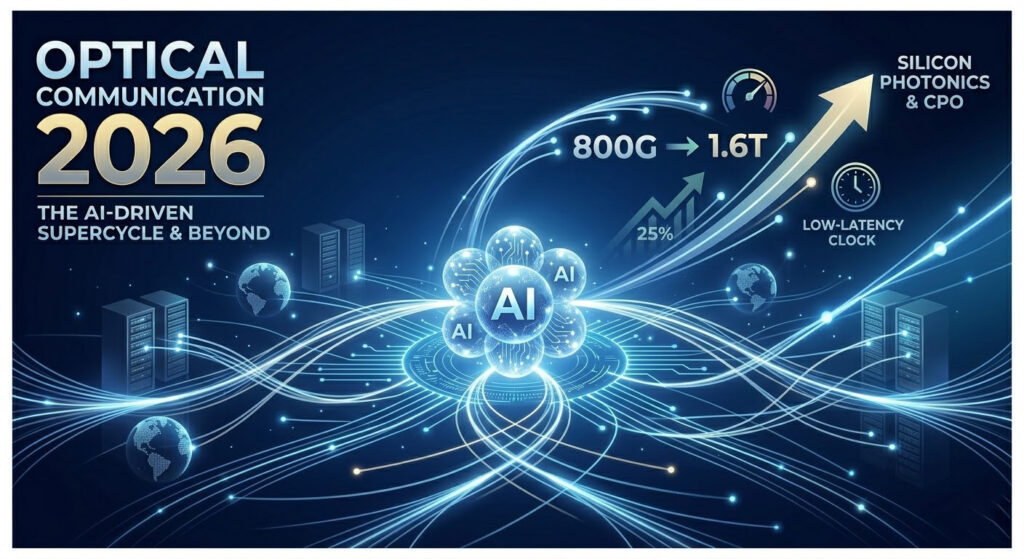
The optical communication industry is entering a new phase of accelerated growth, driven by the rapid expansion of AI infrastructure. What was once a telecom-focused market is now evolving into a critical foundation for global computing systems.
As hyperscale AI data centers continue to scale, optical connectivity solutions are becoming essential for enabling high-speed, high-density, and low-latency data transmission.
In recent years, demand has shifted from traditional telecom networks to AI data centers operated by cloud providers such as Amazon Web Services, Google, and Meta.
Unlike conventional networks, AI clusters require significantly higher bandwidth and interconnect density, driving strong demand for:
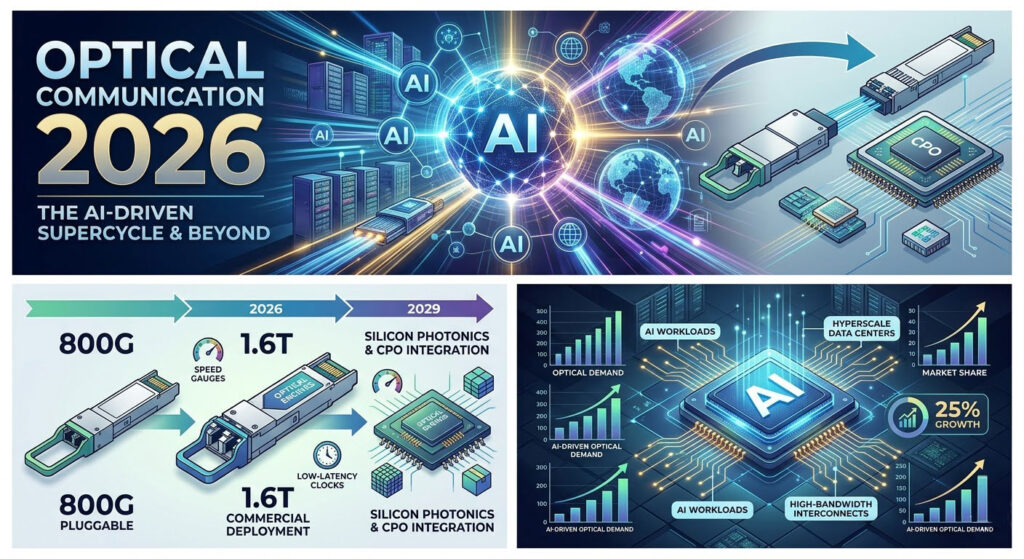
According to industry data, the global optical module market exceeded USD 23 billion in 2025 (Source: STCN), and is expected to grow by approximately 25% in 2026 (Source: FXBaogao).
The industry is rapidly transitioning to higher transmission speeds to support AI workloads.
As GPU clusters scale, data transfer between servers must match computing performance, making high-speed optical interconnects a critical component of AI infrastructure.
Over the next 1–2 years, 1.6T technologies are expected to move toward broader commercialization, especially in hyperscale data centers.
Despite strong demand, the optical communication supply chain still faces constraints, particularly in:
These challenges are accelerating vertical integration across the industry.
Companies that control key technologies—from optical components to fiber management systems—are better positioned to ensure supply stability.
Beyond speed upgrades, new technologies are reshaping the industry:
Silicon photonics is gaining traction due to its scalability and integration advantages. Market forecasts suggest it could reach USD 10 billion by 2029 (Source: Eastmoney Research).
CPO represents a major architectural shift by bringing optical interfaces closer to computing chips, improving power efficiency and bandwidth density.
The market is shifting from individual components to complete data center connectivity solutions.
Instead of standalone optical modules, customers increasingly demand:
This reflects the growing complexity of AI data centers, where performance and scalability must be optimized at the system level.
In 2026, the optical communication industry will continue to grow, driven by:
Looking ahead, key trends include:
The optical communication industry is no longer just a support layer for telecom networks—it has become a core foundation of AI infrastructure.
As AI scales, demand for high-speed optical connectivity will grow exponentially, not linearly.
For companies across the ecosystem, success will depend not only on delivering faster optical components, but on enabling next-generation data center architectures.